Vision
To Empower Institutional Transformation for a Sustainable Tomorrow.
To Empower Institutional Transformation for a Sustainable Tomorrow.
USM is committed to mainstreaming sustainable development in the core areas of the university to produce graduates and staff with first class skills and thinking, research excellence, community engagement and best practices that will make USM a sustainability-led university of world-class standing.
Mainstream sustainability into the core mission areas of USM to secure the future we want for all.
A whole-system approach covering teaching, research, community engagement and institutional arrangement, aligned with the 17 Sustainable Development Goals.
The University Sustainability Council monitors implementation, meets at least three times a year under the chairmanship of the Vice-Chancellor, and receives the annual sustainability reports compiled by the University Sustainability Office from the Sustainability Officer of each Centre of Responsibility (Sections 8.1, 9.0, 10.0 and 11.0).
Endorsed by the University Sustainability Council. Most recent amendment 1 August 2025, effective 2 August 2025.
If the document does not display, open the PDF directly.
Governance and leadership
USM provides participatory bodies through which local stakeholders can take part in university decision making. The Sustainability Policy provides three participatory bodies and mechanisms for stakeholder engagement. Section 7.4.4, Collaborative Programmes (p. 9), commits USM to hold collaborative discussion with stakeholders on sustainability issues and best practice through forums or conferences, and to work with stakeholders to develop and support programmes that promote the sustainability agenda. Section 8.1 (p. 10) establishes a University Sustainability Council (USC) to monitor, evaluate and strategise the transformation, with the University Sustainability Office as secretariat. Section 10.0 (p. 11) places all sustainability initiatives under the purview of the USC, which meets at least three times a year under the chairmanship of the Vice-Chancellor, and requires each Centre of Responsibility to organise sustainability programmes for students, staff and members of the public. The Constitution of Universiti Sains Malaysia also provides a participatory body at the highest level: the Board of Governors, the University’s highest governing body, includes one person to represent the community at the place where the University is located (Section 18(1)(d), p. 110), so that local stakeholders have a voice in university decision making.
The 21st Asia-Pacific University–Community Engagement Network (APUCEN) Summit was hosted by USM at the AC Hotel, Penang, on 16 December 2025 under the theme COMPASSION: Empowering Communities, Driving Sustainability, together with the 21st APUCEN Regional Council Meeting.
The Regional Centre of Expertise (RCE) Penang, hosted by USM together with the School of Educational Studies and the School of Communication, received two RCE Awards 2025 from the United Nations University Institute for the Advanced Study of Sustainability (UNU-IAS) at the 14th Global RCE Conference in Okayama, Japan, reported on 21 October 2025.
Student participation is organised through the Green Ambassadors, whose fourth Appreciation Night was reported on 6 July 2025.
The University Sustainability Council (USC) met twice in 2025, in August and December.
RCE Penang, hosted by USM, is a network of partners from the voluntary, public, education and business sectors (About RCE Penang). Its mangrove conservation project works with the Kedah and Penang Forestry Departments as government partners and with the Penang Inshore Fishermen Welfare Association and Kelab Pendidikan dan Kebajikan Puncak, Merbok as community partners.
Teaching, learning and research
USM has a lifelong learning access policy that ensures access to lifelong learning is open to all, regardless of gender, race, religion, social status or disability. Section 6.9 of the Sustainability Policy, Quality Education [SDG4] (pp. 6–7), states: It is the rights of everyone to get educated, irrespective of gender, race, religion, social status, or physical disabilities. It adds that access towards education should be widely open, so that no one is left behind due to accessibility issues, and commits USM to ensuring equitable access to lifelong learning opportunities for all members of society, including adult learners, senior citizens, persons with disabilities, refugees, indigenous communities, and economically disadvantaged groups, through flexible pathways such as micro-credentials, continuing education, online learning, and community-based training programmes.
On 8 November 2025, the School of Health Sciences held the community programme From Waste to Wealth at Masjid Kampung Lak Lok, Mukim Pelagat, Besut, Terengganu, for 34 B40 women from the local rural community. It combined a 3R (reduce, reuse, recycle) awareness talk, an interactive quiz, a product marketing talk and a hands-on soap-making practical using used cooking oil, and each participant received a soap-making kit to continue making products at home (School of Health Sciences report, 28 November 2025).
Flexible pathways for learners outside the university are provided through Micro-credential@USM, which issues digital certification of skills and competency (Micro-credential@USM), and MOOC@USM, which offers general courses for the public and community as an open online platform (MOOC@USM).
Institutional arrangement
USM has a policy to maximise water reuse across the university. USM's water reuse policy is set out in Section 6.1 of the Sustainability Policy (p. 3), which states: We should maximize water reuse across the university, reduce water consumption on campus and integrate sustainable water management practices throughout the campus by 2030. The same section promotes sustainable and integrated water resources management through water quantity and quality monitoring, water availability information sharing and the participation of local communities, and the Policy was last amended on 1 August 2025.
The USM Sustainability Action Plan has been adopted to highlight the USM Sustainability Policy and procedures on water, energy, health, agriculture, biodiversity and ecosystem management, and climate change and disaster risk management, which have been conceptualised to meet the priorities of national and local needs.
According to the action plan, USM aims to integrate a sustainable water management plan on campus, with the following vision and missions:
The commitment is put into practice through water infrastructure on campus, under initiatives of the Facilities Development & Management Department (JPPF). The Bio-Ecological Drainage System (BIOECODS) at the Engineering Campus harvests stormwater in interconnected ponds with a combined capacity exceeding 30,000 m³, supplying laboratory use, hydraulic testing and landscape irrigation. Rainwater harvesting tanks at the School of Civil Engineering and the Health Campus (two 4,000-gallon tanks) are used for irrigation, toilet flushing and car washing, the School of Humanities operates the IoT-enabled SmartDrops rainwater system, and the Clinical Diagnostic Laboratory, PPUSMB, reuses condensate and distilled water.
The Bio-Ecological Drainage System (BIOECODS) was recognised as a UNESCO Ecohydrology Demonstration Site by the Scientific Advisory Committee of the UNESCO Ecohydrology Programme on 1 October 2024, and the recognition was reported by USM on 14 April 2025. USM received the Ecohydrology Research Award for this status at the national World Water Day 2025 celebration in Kuantan, Pahang, in 2025 (Engineering Campus report).
At Universiti Sains Malaysia (USM), we prioritise sustainable water management by reusing water across various facilities. USM measures the reuse of water across the university: the total volume of water reused at USM is approximately 400,500 litres, contributing to significant water conservation efforts. The measurement distinguishes three sources of reused water: recreational ponds and tube well tanks, rainwater rooftop tanks, and wastewater from the Haemodialysis Unit.
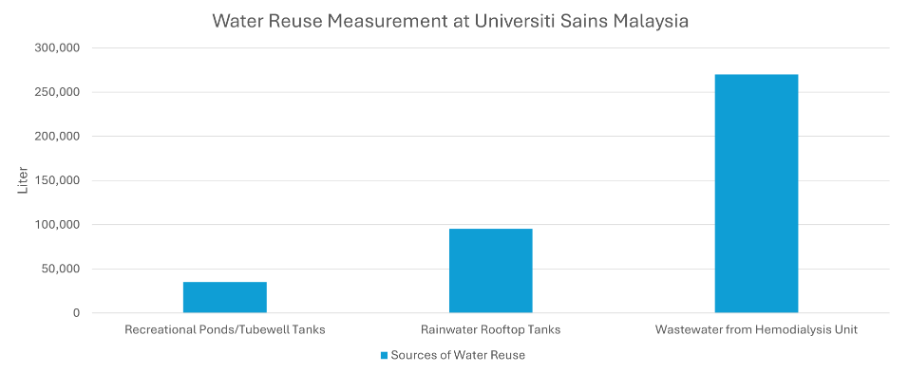
The Haemodialysis Unit at the Health Campus reuses approximately 270,000 litres of water. This water is filtered through a reverse osmosis machine and would typically be discarded during the dialysis process. However, USM has found a way to reuse this high-purity water, ensuring it meets all biochemical and bacteriological standards for safe use. Through these measures, USM continues to enhance water conservation practices in line with its Sustainability Policy, focusing on efficient resource management and environmental responsibility.
At USM, water reuse initiatives are being implemented in various capacities to address the growing global water crisis and promote sustainable resource management. The key approaches being adopted are described below.
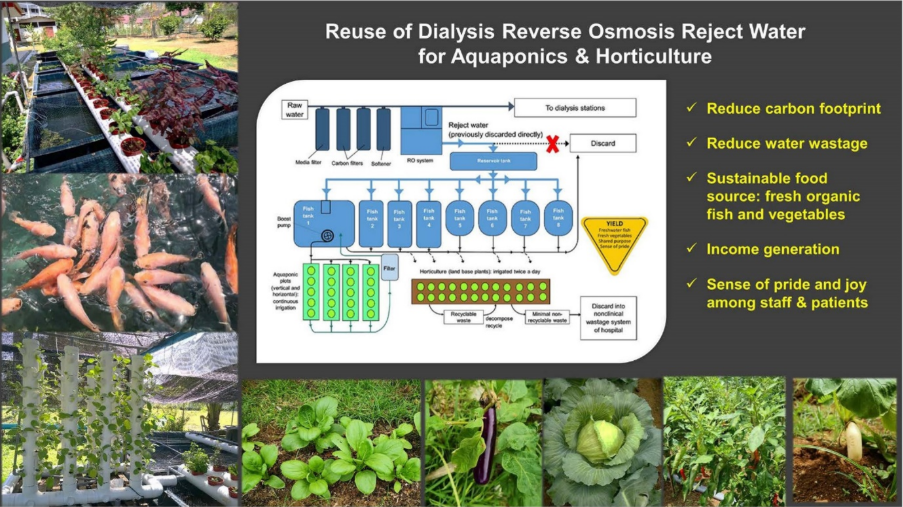
Reuse of reverse osmosis (RO) wastewater from haemodialysis. The Haemodialysis Unit at the USM Health Campus reuses wastewater generated from its reverse osmosis machines. These machines produce high-quality water for dialysis, but approximately 60–70% of the source water is discarded during the process. This reject water is now being reused in aquaponics and horticulture projects. The water, rich in nutrients, is piped to fish tanks and hydroponic systems where it supports the breeding of fish (such as tilapia) and the growth of various vegetables like bok choy, corn and cauliflower. This project not only conserves water but also promotes environmental sustainability by reducing the unit’s carbon footprint, creating a sustainable food source and fostering a sense of shared responsibility among staff and patients.
Rainwater harvesting. At the main USM campus, rainwater harvesting systems have been installed, enabling the reuse of rainwater for various applications. This effort contributes to reducing dependency on treated water and promotes water conservation.
These approaches showcase USM’s commitment to environmental protection and sustainable water management.
Institutional arrangement
USM has a policy on preventing and reducing marine pollution of all kinds, in particular from land-based activities. Section 6.5 of the Sustainability Policy, Life Below Water and Life on Land, states on p. 4: We shall also implement a marine pollution prevention policy aimed at reducing marine pollution of all kinds, particularly from land-based activities. This includes proper wastewater and runoff management, minimizing plastic and chemical discharge into waterways. The same page links the health of marine ecosystems to the protection of water quality, habitat restoration and sustainable land use in coastal zones. The Policy also addresses plastics and single-use items (Section 6.7) and water management (Section 6.1), described elsewhere on this page.
In 2025, the Centre for Marine and Coastal Studies (CEMACS) and the Centre for Drug Research (CDR) took part in the International Coastal Cleanup (ICC) 2025, launched at Pantai Seagate, Penang on 20 September 2025 and officiated by the CEMACS Director. A total of 198 participants joined, including USM staff, students, community volunteers and partner organisations, and the campaign ran until 20 October 2025, with data collected for a global marine-debris database (CDR activity report). On 13 December 2025, student volunteers from the Green Ambassadors, EPEHub and USM also planted 6,490 mangrove saplings at Sungai Burung, Balik Pulau, with JKS Voltsvan, the Penang Island City Council and the Penang State Forestry Department. About 80 USM students took part among roughly 260 volunteers.
Institutional arrangement
USM has a policy on waste disposal to measure the amount of waste sent to landfill and recycled. Section 6.7 of the Sustainability Policy (pp. 5–6) provides the basis for USM's landfill policy, committing USM to precise and sustainable waste management operations and to the "waste to wealth" concept of transforming waste into valuable resources, with the aim of a low-carbon campus. Measurement is built into the Policy: the Sustainability Officer of each Centre of Responsibility plans strategies for the collection and preparation of sustainability data (Section 8.2.6, p. 10) and prepares an annual report of sustainability activities (Sections 8.2.7 and 11.0, pp. 10–11), which the University Sustainability Office monitors once a year (Section 9.0, p. 11).
In practice, waste generated and recycled is tracked annually across all campuses and operational units. In 2025, USM measured 2,949.2 tonnes of waste generated across the whole university, of which 875.7 tonnes (29.7%) were recycled and 2,073.5 tonnes (70.3%) were sent to landfill. The Green Office and Green Desasiswa programmes and campus-wide waste segregation support this. Food waste from the main-campus cafeterias is measured through the USM Green Pulse platform.
The Green Office Sustainability Audit and rating, run through Kampus Sejahtera, assessed 120 submissions in 2025. Results were announced at the USM Green Office Rating Award Ceremony on 22 December 2025, when 72 responsibility centres attained five leaves and 32 attained four leaves (Engineering Campus report; School of Industrial Technology notice).
On 22 May 2025, the Health Campus held a recycling campaign during its Sustainability Week to promote the 3Rs (reduce, reuse, recycle) (ARASC report).
Institutional arrangement
USM has policies around use minimisation of plastic. Section 6.7 of the Sustainability Policy (p. 6) sets out USM's policy for minimisation of plastic use and states that the University can create a low-carbon campus by minimising the use of plastics and single-use plastic in the campus, that USM adopts Malaysia's Roadmap Towards Zero Single-use Plastics to minimise plastic use in the campus, and that USM addresses single-use plastics by encouraging cafe operators to use eco-friendly products. It also calls for awareness-raising among students, faculty and staff through educational programmes and campaigns, and for collaboration with local organisations and businesses on joint initiatives.
Visible Single-Use Plastic-Free Zone campaigns include Say No to Plastic – #GreenRamadan and Bring Your Own Food Container for Iftar.
On 12 September 2025, USM took part in COSDEM 2025, a one-day conference on sustainability in Malaysian education held in Nibong Tebal, Penang, on the theme Combat Single Use Plastic, with the Green Educators Workgroup, local authorities, NGOs and corporate partners (Engineering Campus report).
Institutional arrangement
USM has a policy on reducing plastic waste on campus. USM's policy on plastic waste reduction on campus is set out in Section 6.7 of the Sustainability Policy (pp. 5–6), which states that USM adopts Malaysia's Roadmap Towards Zero Single-use Plastics to minimise plastic use on campus, addresses single-use plastics by encouraging cafe operators to use eco-friendly products, and should raise awareness of the environmental impact of plastic through educational programmes and campaigns. USM has an action plan in place to reduce plastic waste on campus: the USM Action Plan to Reduce Plastic Waste on Campus sets targets of at least 80% of the main campus designated plastic-free by 2026 and 100% across all campuses by 2030.
Universiti Sains Malaysia (USM) implements an action plan to reduce plastic waste on campus through its single-use plastic ban, the Bring Your Own Bag, Bottle and Container (BYOB) campaign, and the establishment of reusable-consumption facilities within campus cafeterias. Coordinated through the Office of the Deputy Vice-Chancellor for Industry and Community Network (BJIM), these initiatives encourage staff, students, food-service operators and campus visitors to reduce their reliance on disposable plastics and adopt more sustainable consumption practices.
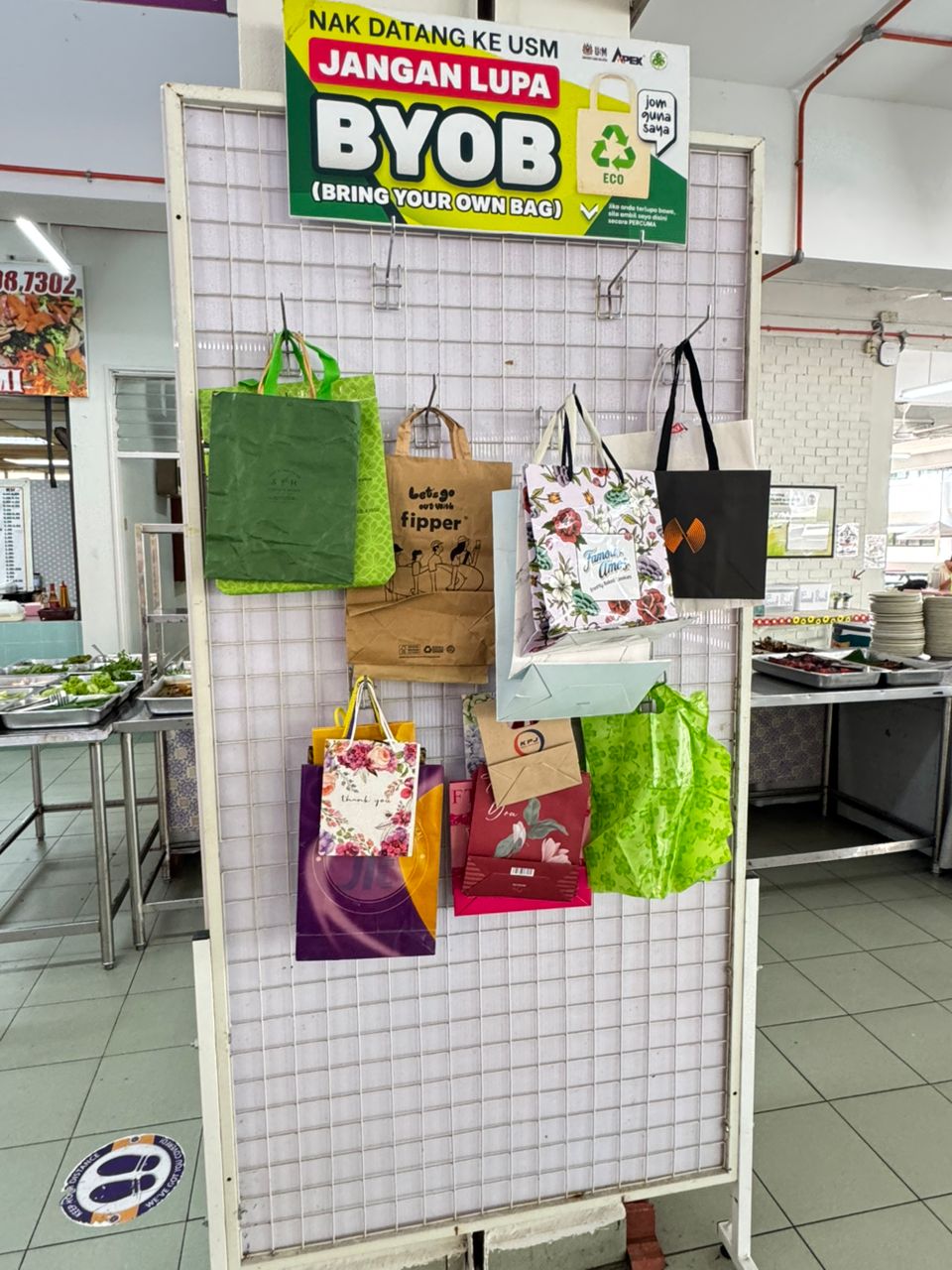
USM’s approach combines institutional requirements and enforcement with practical initiatives that make reusable alternatives part of everyday campus life. The BYOB campaign is promoted across USM cafeterias, while a dedicated BYOB Corner has been established at Harapan Café to encourage the university community to bring and use reusable containers. Together, these measures support USM’s wider objective of reducing single-use plastic consumption and strengthening sustainable practices across campus operations.
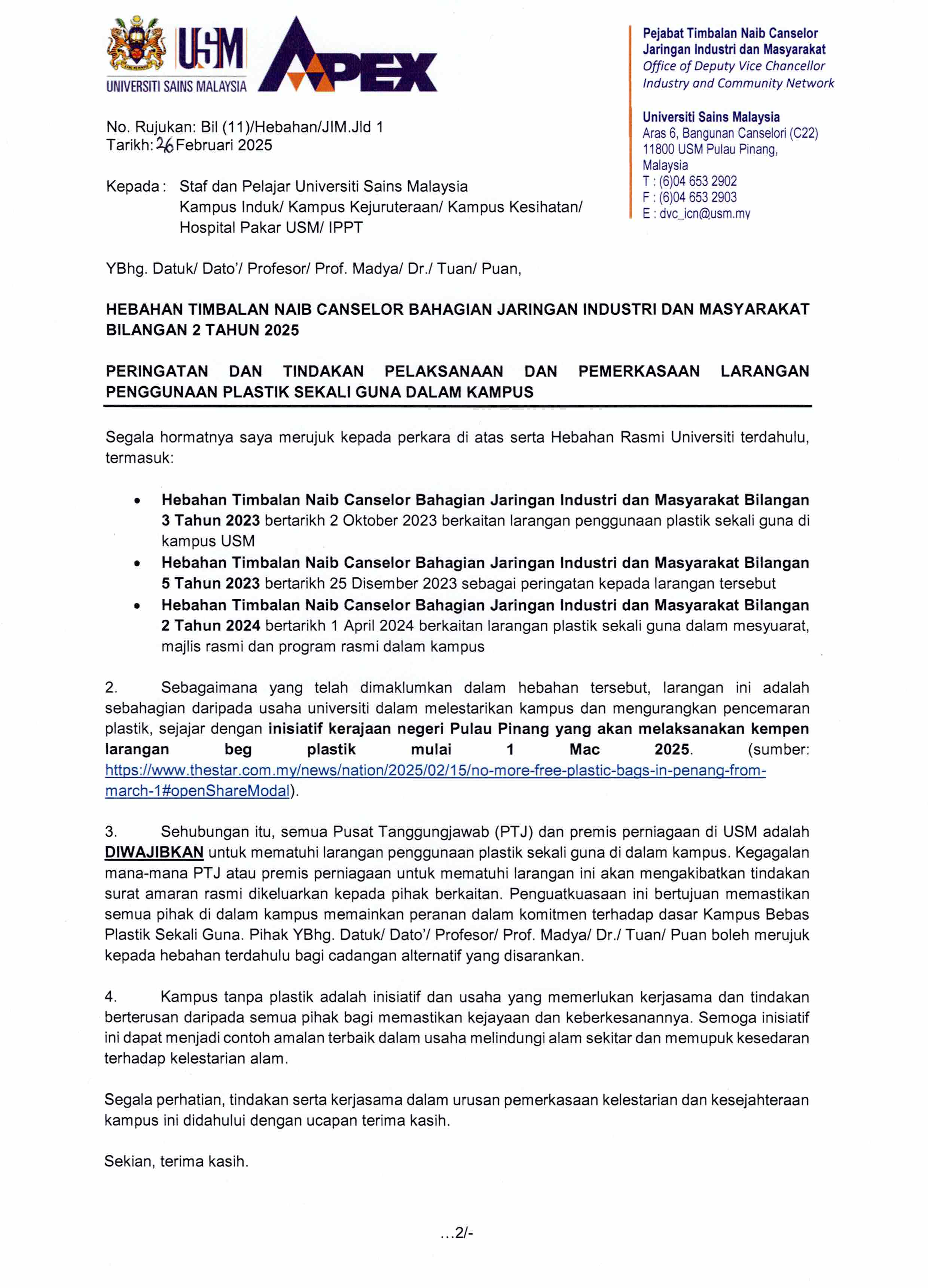
A key element of the plan is the official BJIM announcement, Hebahan Timbalan Naib Canselor Bahagian Jaringan Industri dan Masyarakat Bilangan 2 Tahun 2025: Peringatan dan Tindakan Pelaksanaan dan Pemerkasaan Larangan Penggunaan Plastik Sekali Guna Dalam Kampus (Announcement No. 2 of 2025 of the Deputy Vice-Chancellor for Industry and Community Network: Reminder and Implementation Action on Strengthening the Ban on Single-Use Plastics on Campus), dated 26 February 2025. Addressed to USM staff and students across the Main Campus, Engineering Campus, Health Campus and USM Specialist Hospital, the announcement reiterates the university’s requirements for implementing and enforcing the prohibition of single-use plastics on campus.
The announcement refers to earlier institutional notices, demonstrating that the restriction is supported by continuing administrative communication rather than a one-off awareness campaign. It explains that the ban forms part of USM’s efforts to make its campuses more sustainable and reduce plastic pollution, in alignment with the Penang state government’s initiative to implement a single-use plastic bag ban from 1 March 2025.
Importantly, BJIM states that all departments/centres and business premises operating within USM are required to comply with the campus single-use plastic ban. The announcement further specifies that failure to comply may result in an official warning letter being issued to the departments/centres or business operators. This establishes a formal enforcement mechanism to support implementation and accountability across campus operations.
Complementing the institutional ban, USM promotes the Bring Your Own Bag, Bottle and Bekas (Container) (BYOB) campaign across cafeterias to encourage the use of reusable alternatives in daily food and beverage purchases. The campaign encourages students, staff and other campus users to bring reusable shopping bags, refillable water bottles and personal food containers instead of relying on disposable bags, beverage containers and takeaway packaging.
Cafeterias are important settings for this initiative because food and beverage transactions can generate single-use plastic waste through takeaway containers, packaging and beverage bottles. Promoting BYOB practices across USM cafeterias encourages the university community to make reusable products part of routine purchasing and consumption.
The campaign complements the campus plastic ban in two ways. First, the ban establishes the institutional requirement to restrict single-use plastics. Second, BYOB provides a practical behavioural response by encouraging campus users to arrive prepared with reusable alternatives. By promoting these practices across cafeteria settings, USM integrates plastic-waste reduction into everyday campus activities rather than relying exclusively on general environmental awareness messages.
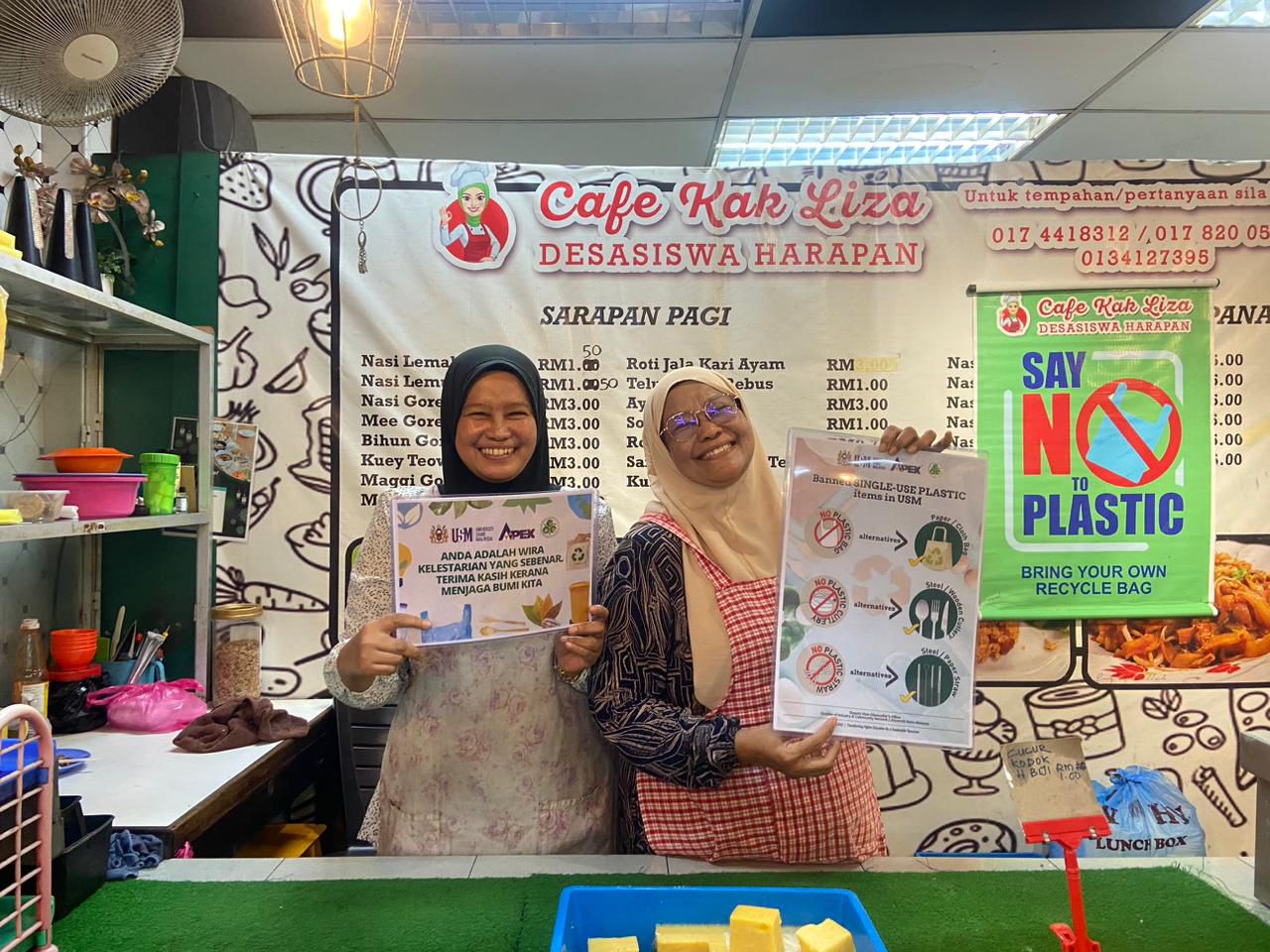
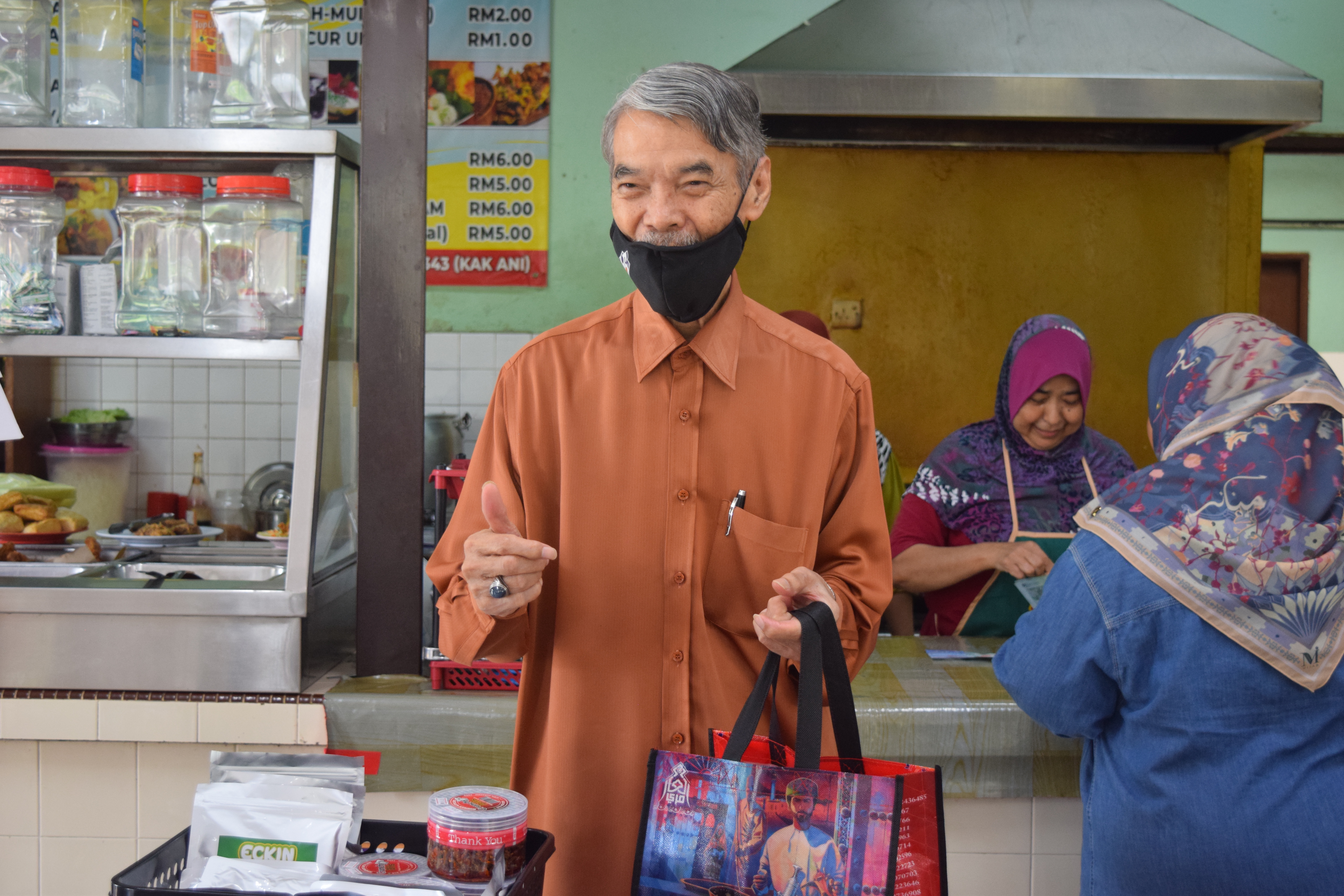
USM has also established a BYOB Corner at Harapan Café as a practical initiative to promote reusable-container practices within the campus food-service environment. The dedicated corner reinforces the BYOB campaign by providing a visible point of engagement at a university café and encouraging the campus community to participate in reducing disposable packaging. It helps make the BYOB message more visible in the setting where reusable bags, bottles and food containers can replace disposable alternatives.
Together, the BYOB campaign across USM cafeterias and the BYOB Corner at Harapan Café demonstrate how the university promotes reusable consumption practices at both a campus-wide and location-specific level. These initiatives support the transition towards reduced reliance on single-use plastics and reinforce the university’s wider campus sustainability efforts.
At the Earth Day 2025 Drive-Thru Recyclables Collection Programme at Padang Kawad, organised by the Division of Industry and Community Network with E-Idaman and Circular+, campus members traded plastics (PET, HDPE and PP) and other recyclables for cash or app credits (CDR activity report, 22 April 2025).
Institutional arrangement
USM has a policy to ensure that food on campus that comes from aquatic ecosystems is sustainably harvested. USM's policies on food from aquatic ecosystems are set out in Section 6.5 of the Sustainability Policy (p. 4), which states: USM shall adopt a sustainable seafood procurement policy to ensure that all seafood and aquatic-based food served on campus are sourced from environmentally responsible and certified fisheries or agriculture operations. This policy also encompasses measures to sustainably manage fisheries activities to prevent overharvesting, preserve our rich biodiversity and reduce the vulnerability of environmentally sensitive areas. The same section states that USM should address aquaculture in controlled environments, covering site selection, environmental impact assessment, water quality, disease and feed management, and the use of antibiotics and chemicals, and that responsible aquaculture practices must minimise negative impacts on ecosystems, animal welfare and public health.
On 8 April 2025, CEMACS briefed a visiting delegation of 30 members from AICHR and ASOEN on its aquaculture work with communities, its study of non-feed aquaculture as a food security measure, and its monitoring of coastal species such as oysters, clams, abalone and sea urchins as it moves toward green mariculture. On 17 November 2025, CEMACS presented its ongoing oyster farming and sea grape (latok) cultivation projects to the Secretary-General of the Ministry of Agriculture and Food Security and the Director General of the Department of Fisheries Malaysia.
Institutional arrangement
USM has policies to ensure that food on campus is sustainably farmed. USM's policies to ensure sustainably farmed food on campus begin with Section 6.4 of the Sustainability Policy, Zero Hunger and No Poverty (pp. 3–4), which states that the University promotes sustainable farming practices that minimise soil erosion, water pollution and greenhouse gas emissions, including conservation programmes, organic farming support and agroecological approaches, and that staff and students should be encouraged to support the agricultural sector in food production, distribution and consumption. Section 7.3.1(c) (p. 9) adds the requirement to prioritise the purchase of products from sustainable sources, especially local vendors.
Staff of the Nutrition and Dietetics Unit grow pesticide-free vegetables in hydroponic pipes behind the kitchen of Hospital Pakar Universiti Sains Malaysia (HPUSM) as a sustainability project. A harvest was reported on 18 November 2025.
Institutional arrangement
USM has a policy to ensure the conservation, restoration and sustainable use of terrestrial ecosystems associated with the university, in particular forests and mountains. USM's policy on the sustainable use, conservation and restoration of land is set out in Section 6.5 of the Sustainability Policy (p. 5), which sets USM's priorities for all life on land: to document and assess the value of ecological goods and services, protect endangered species from extinction, sustainably manage human activities such as agriculture and urbanisation, and avoid land degradation. It adds: We are committed to ensure conservation, restoration and sustainable use of terrestrial ecosystems associated with the university, particularly forests, mountains and wetlands, through an explicit policy that guides our efforts in these areas. Section 7.3.4(b) (p. 9) adds the Campus Development commitment to preserve heritage and biodiversity.
On 31 August 2025, the Reconstructive Sciences Unit of the School of Medical Sciences, with the Bachok District Council, held a Beach Plogging and coconut tree planting programme at Pantai Kemasin, Bachok, Kelantan, in which 40 volunteers planted 10 coconut trees along the shoreline and collected 30 bags of litter.
Institutional arrangement
USM has a policy to identify, monitor and protect IUCN Red Listed species and national conservation list species with habitats in areas affected by the operation of the university. USM's policy on monitoring IUCN and other conservation species is set out in Section 6.5 of the Sustainability Policy (p. 5), which states: USM also commits to identify and monitor IUCN Red Listed species and national conservation list species within or nearby university-operated land areas, to ensure our operations do not disrupt their habitats. We will also support efforts to protect them. The section adds that regular diversity surveys, species recording and reporting by staff and students, and roost monitoring are practices that can be undertaken to protect, conserve and monitor IUCN Red Listed species.
On 17 November 2025, CEMACS presented its long-term environmental monitoring, biodiversity assessments, coastal habitat restoration work and the research collections of its Biodiversity Museum to the Secretary-General of the Ministry of Agriculture and Food Security and the Director General of the Department of Fisheries Malaysia. The Marine Research Station of CEMACS monitors coastal and marine sites including Teluk Aling, the Middle Bank seagrass bed, Pulau Jerejak and Batu Uban (USM Sustainability: biodiversity and ecosystem).
Institutional arrangement
USM has a policy to reduce the impact of alien species on campus. USM's policy on alien species impact reduction is set out in Section 6.5 of the Sustainability Policy (p. 5), which states: We are developing frameworks to assess the potential risks associated with introducing alien species, covering the likelihood of establishment, spread and ecological impact, and that measures are put in place to prevent the intentional or accidental introduction of invasive species, such as through regulations on trade, transportation, and importation. USM also needs to emphasise early detection and rapid response to new or emerging alien species, supported by surveillance systems, monitoring networks and protocols for reporting and assessing potential invasive species.