Universiti Sains Malaysia is governed under the Constitution of Universiti Sains Malaysia, which establishes the Board of Governors, the Senate and the student and employee bodies through which the university community takes part in governance.
C
The Constitution
The Constitution of Universiti Sains Malaysia (P.U. (A) 220, gazetted on 1 July 2011 under the Universities and University Colleges Act 1971) sets out the Authorities of the University, their composition and the bodies through which students and employees take part in governance. Page numbers on this page refer to the English text of the Constitution in the PDF.
USM has elected representation on the university’s highest governing body from faculty, and representation from students (both undergraduate and graduate) and staff (non-faculty employees) in the Authorities of the University established by the Constitution. Under Section 21(1) (p. 112), the Board of Governors is the governing, policy making and monitoring body of the University. Section 18(1) (pp. 109–110) provides that the Board consists of a Chairman, the Vice-Chancellor, two officers of the public service, one person to represent the community at the place where the University is located, two professors of the University elected by the Senate from amongst the members mentioned in paragraph 24(1)(d), and four persons from the private sector or professional bodies, the Alumni and others appointed by the Minister.
Representation of faculty, students and staff in the governing structures of Universiti Sains Malaysia
Constituency
Body
How representatives are chosen
Constitution
Faculty
Board of Governors, the highest governing body
Two professors of the University are elected by the Senate from among the professors elected to the Senate. Those professors are elected for a term of three years by all full-time professors and associate professors.
Sections 18(1)(e) and 24(1)(d), pp. 109–110 and 115–116
Students (both undergraduate and graduate)
Student Welfare Committee, an Authority of the University
Two members are elected by the Students’ Consultative Assembly, which consists of the Students’ Representative Council, elected by secret ballot by the registered students, and representatives of student bodies.
Sections 17(1), 35(1)(d), 64(1) and 70(5), pp. 109, 127, 143 and 146
Staff (non-faculty employees)
Employee Welfare Committee, an Authority of the University
The Committee, chaired by a member of the Board, includes the Vice-Chancellor, the Registrar, the Bursar and a member from each registered employee union or employee association of the University.
Sections 17(1) and 34(1), pp. 109 and 126
Section 17(1) (p. 109) lists the Board, the Senate, the Employee Welfare Committee and the Student Welfare Committee among the Authorities of the University.
02
Students’ union
USM recognises a students’ union through the Constitution. Section 70(1) (p. 145) provides that the registered students of the University, other than external students, together constitute the Students’ Union of the University. Every registered student is eligible to contest a seat in the Students’ Representative Council (SRC), known as the Majlis Perwakilan Pelajar (MPP) (Section 70(2), p. 145), which is elected by the Union by secret ballot within forty five days of the start of the academic year for a term of one year (Sections 70(4) and 70(5), pp. 145–146).
Governance input
The SRC participates in the Students’ Consultative Assembly and is represented on bodies undertaking student welfare activities (Section 70(11)(d) and (e), p. 147). The Assembly is a forum for consultation between students and their representatives through question and answer sessions, debates and motions (Section 64(3), p. 144), and it elects two members of the Student Welfare Committee (Section 35(1)(d), p. 127).
Support for students
The SRC makes representations to the Vice-Chancellor on all matters relating to the living and studying conditions of students (Section 70(11)(c), p. 147), and organises and supervises student welfare activities, including the supply of meals and refreshments, subject to the direction of the Vice-Chancellor (Section 70(11)(b), p. 147).
Social activities
The SRC fosters a spirit of community life among the students of the University (Section 70(11)(a), p. 147) and organises recreational facilities and spiritual and religious activities as part of student welfare activities (Section 70(11)(b), p. 147).
What USM did in 2025
The Board of Governors approved the renaming of the Students’ Consultative Assembly (Dewan Perundingan Pelajar) as Parlimen Mahasiswa on 18 December 2024, and the Vice-Chancellor launched its Standing Order handbook on 11 January 2025.
On 21 June 2025, the second sitting of Parlimen Mahasiswa for the 2024/2025 session opened with the selection of the MPP Selection Committee, followed by a special MPP Question Time and the debate of more than 15 motions, including a motion to open a Postgraduate Diploma in Education programme at USM, which was passed unanimously.
Fair Employment
Universiti Sains Malaysia applies fair employment practices to its staff and faculty, covering the living wage, recognition of unions and labour rights, the appeal process, and tracking of the pay scale for gender equity.
01
Living wage for all employees
Universiti Sains Malaysia pays all staff and faculty at least the local living wage. Malaysia defines the local wage standard in the Minimum Wages Order 2024 [P.U. (A) 376], made under the National Wages Consultative Council Act 2011 (Act 732). The Order sets the minimum wage payable to an employee at RM1,700 a month, or RM8.72 an hour, with effect from 1 February 2025 (paragraph 3(1), p. 7).
USM follows this rate. In 2025, all USM staff and faculty were paid at least RM1,700 a month, the rate in force under the Order from 1 February 2025, so no employee was paid below the local living wage. The salaries of USM employees are set within the Public Service Remuneration System (Sistem Saraan Perkhidmatan Awam, SSPA), implemented through Pekeliling Perkhidmatan Bilangan 1 Tahun 2024 – Pelaksanaan Sistem Saraan Perkhidmatan Awam bagi Pegawai Perkhidmatan Awam Persekutuan, issued by the Jabatan Perkhidmatan Awam (JPA).
The living wage commitment therefore applies to every category of USM employee, academic and non-academic, and is consistent with the national wage standard for 2025. Section 7.1 of the Sustainable Employment and Worker Wellbeing Policy also requires the basic pay of employees covered by minimum wage law to be no less than the minimum rate in force, and allows USM to assess the adequacy of remuneration and benefits in the light of the cost of living and the welfare of its workers.
02
Recognition of unions
Universiti Sains Malaysia recognises unions, including freedom of association and collective bargaining, for all employees, including women and international staff. Employment relations at USM are governed by the Industrial Relations Act 1967 (Act 177), and the University facilitates communication between employee representatives and management.
Section 7.4 of the Sustainable Employment and Worker Wellbeing Policy recognises staff associations, trade unions and the Departmental Joint Council (Majlis Bersama Jabatan, MBJ) as legitimate channels of dialogue and consultation, and provides that no employee may be treated adversely solely because of lawful membership of, or participation in, an association or union. Staff are represented in the MBJ by two bodies: the Persatuan Kakitangan Akademik dan Pentadbiran USM (PKAPUSM), for academic and administrative staff, and the Kesatuan Kakitangan Am Universiti Sains Malaysia (KKAUSM), for general staff.
The Kesatuan Kakitangan Am Universiti Sains Malaysia (KKAUSM, Registration No. 506) is the registered union for the general staff of USM and champions their rights through an elected committee. KKAUSM represents staff on matters of employment, welfare and professional development, and it has a written Standard Operating Procedure (2025) under which member complaints are taken up with the USM management (see Section 03).
03
Fair and transparent appeal process
As a statutory public university, Universiti Sains Malaysia provides a process for employees to appeal on employee rights and/or pay. The process is established under the Laws of Malaysia Act 605 – Statutory Bodies (Discipline and Surcharge) Act 2000 [amendment as at October 2021], which sets out a transparent procedure for disciplinary and employment-related appeals.
The Sustainable Employment and Worker Wellbeing Policy also provides complaint, appeal and remedy channels for employees. One of its objectives is to provide complaint, appeal and remedy channels that are fair, confidential, accessible and free from retaliation (Section 3, p. 2), and its scope covers employment matters including remuneration, performance management, promotion, complaints, appeals and discipline (Section 4, p. 2). Section 9 (p. 7) requires complaints to be received, recorded and assessed, investigated objectively, and followed by remedies that may include correcting decisions or records, and it prohibits retaliation against anyone who raises a concern in good faith.
Employees can also raise employee-rights and pay matters collectively. Proposals from KKAUSM and PKAPUSM members are submitted to the Departmental Joint Council (Majlis Bersama Jabatan, MBJ) through a standard proposal form, which states the problem, the department concerned, and the proposed solution with its justification and financial implications. KKAUSM minutes of the MBJ are circulated to its committee.
According to page 9 of the Act, any staff member found guilty of a disciplinary offence may submit an appeal to the Jawatankuasa Rayuan Tatatertib. The framework for this committee is set out in Bahagian II: Jawatankuasa Rayuan Tatatertib (pp. 62–65), which specifies its composition, powers, conflict-of-interest declarations, meeting procedures and the process for determining appeal outcomes.
Practice in 2025
KKAUSM, as the recognised body that handles issues of the general staff of USM, has a Standard Operating Procedure for the employee complaint form (Borang Aduan Pekerja), updated on 23 January 2025 and endorsed on 3 February 2025 (pp. 8–9). The KKAUSM committee receives the complaint, checks the membership status and supporting documents, investigates together with the Disciplinary and Legal Committee for member complaints, and presents a report to the working committee meeting. The committee then decides whether to refer the case to the member complaints bureau or to take it to the USM management, with which it holds consultations to resolve the matter.
04
Tracking pay scale for gender equity
Universiti Sains Malaysia pays salaries under the SSPA (Pekeliling Perkhidmatan Bilangan 1 Tahun 2024), which has a single salary scale for each grade and does not provide different salary schemes for male and female officers. Remuneration at USM therefore follows qualifications, service grade and tenure, and not gender.
USM measures pay scale gender equity in two ways. First, because every grade has one salary scale, pay is equal for male and female officers of the same grade by design. Second, USM benchmarks the national outcome using the Employee Wages Statistics (Formal Sector) Report, Fourth Quarter 2025, because USM salaries are set under the same national Public Service Remuneration System that applies across the formal public sector. The report is, published by the Department of Statistics Malaysia (DOSM) (p. 20). The report shows the median monthly wage of formal employees in Malaysia as follows.
Median monthly wage of formal employees in Malaysia by sex, 2025 (DOSM)
Month (2025)
Male (RM)
Female (RM)
Difference (RM)
Difference as % of male wage
November 2025
2,900
2,827
73
2.5%
December 2025
3,167
3,120
47
1.5%
The gap between the male and female median wage narrowed from 2.5% in November 2025 to 1.5% in December 2025.
USM also provides for tracking within its own workforce. The Gender Equality Policy (Dasar Kesaksamaan Gender, revised 2025; approval of the revised policy is pending) requires a transparent monitoring and reporting system to track progress in implementing gender equality at all levels (Section 3.3, p. 9), and Action 2.1.5 (Appendix A, PDF p. 15) provides for a database of staff data disaggregated by sex, collected consistently and updated every year by the Gender Equality Policy Committee, the Registrar’s Office and the Deputy Vice-Chancellors. Action 6.1 (PDF p. 22) commits USM to the same salary, benefits and allowances for all qualified staff regardless of gender.
05
Recognition of labour rights
Universiti Sains Malaysia recognises and protects labour rights, namely freedom of association and collective bargaining, for all employees, including women and international staff. These rights are exercised through KKAUSM, the officially registered union for the general staff of USM, which is affiliated to the Congress of Unions of Employees in the Public and Civil Services (CUEPACS) and takes part in national consultations on employee welfare, salary structures and working conditions in the public service.
At the university level, the Standard Operating Procedure of KKAUSM (2025, pp. 8–9) sets out the process for submitting complaints and feedback on workplace welfare and discipline. Each case is reviewed by the Jawatankuasa Tatatertib, Disiplin, Perundangan dan Aduan Ahli and then presented to the Mesyuarat Ahli Jawatankuasa Kerja, which decides whether to bring the matter to the USM management.
Equity & Diversity
Universiti Sains Malaysia tracks and supports the participation of underrepresented groups in admissions, recruitment and campus life, and its diversity and equality work is led by the Centre for Research on Women and Gender (KANITA).
01
Access to university: tracking underrepresented groups
Universiti Sains Malaysia (USM) measures and tracks the participation of underrepresented and potentially underrepresented groups in its student body to assess equitable access to higher education. The groups monitored are women, students from low-income households, students with disabilities (PWDs) and students from regional and remote areas. By collecting and analysing this data year by year, USM can see the representation of each group, follow participation trends over successive years and use the evidence to strengthen inclusive admissions.
Participation of underrepresented groups, 2023 to 2025
Participation of underrepresented groups at USM, 2023 to 2025
Student group
2023
2024
2025
Female students
62.4%
63.2%
63.4%
Students with a disability
0.4%
0.6%
0.6%
Students from regional or remote areas
7.2%
7.2%
7.0%
Students from low-income households
24.3%
27.9%
28.2%
Female students
202362.4%
202463.2%
202563.4%
Students with a disability
20230.4%
20240.6%
20250.6%
Students from regional or remote areas
20237.2%
20247.2%
20257.0%
Students from low-income households
202324.3%
202427.9%
202528.2%
Each chart is scaled to the highest value of that group, so the bars compare years within a group, not across groups.
Female students made up more than 60% of the monitored student population in each of the three years, rising from 62.4% in 2023 to 63.4% in 2025. The share of students with disabilities rose from 0.4% in 2023 to 0.6% in 2024 and remained at 0.6% in 2025. The share of students from low-income households rose from 24.3% in 2023 to 27.9% in 2024 and 28.2% in 2025. Students from regional and remote areas accounted for 7.2% in 2023 and 2024 and 7.0% in 2025; continued monitoring of this group lets USM assess geographical representation and identify barriers faced by students from less accessible areas.
Policy framework for monitoring
This monitoring is anchored in USM’s Inclusive Education Policy for Marginalized Students 2025. Section 6.5 (p. 3) requires the University to monitor implementation of the policy through regular assessments, feedback mechanisms and reporting by the responsible parties. Section 8.0 (p. 3) sets the indicators used for that monitoring, including the profiling of students with disabilities in each School by gender, type of disability and course of study. The policy applies alongside Section 8 of the Constitution of Universiti Sains Malaysia, which provides that membership of the University is open to all persons irrespective of gender, race, religion, nationality or class.
Access to university: recruiting underrepresented groups
USM takes planned actions to recruit students, staff and faculty from underrepresented groups. The actions are practical measures linked to its policy commitments: targeted admission strategies and financial support for students, and a policy commitment to equal access to employment together with a staff record system for employees with disabilities.
Recruiting students
Section 6.1 of the Inclusive Education Policy for Marginalized Students 2025 (p. 2) commits USM to targeted admission strategies and inclusive institutional practices for marginalized, underrepresented and disadvantaged groups. The policy provides that students shall not be denied access to education on the basis of disability, socio-economic status, ethnicity, gender, displaced or refugee status, indigenous status or geographic location.
The Siswa SULUNG Malaysia Programme is a key measure for recruiting and supporting first-generation students. It supports students from B40 (low-income) households who are the first in their families to pursue a bachelor’s degree. For the 2025/2026 academic session USM allocated RM2.8 million in educational assistance to 280 Siswa SULUNG recipients. The assistance fully exempts tuition fees, registration fees, recurring fees and other academic fees for the whole four-year period of study, which removes the financial barrier to enrolling and to continuing the degree.
What USM did in 2025
Siswa SULUNG announcement. On 20 September 2025 the Vice-Chancellor announced the RM2.8 million programme for 280 first-generation B40 students in the 2025/2026 session (BERNAMA; Malay Mail).
Recruiting staff and faculty
Section 3.15 of the Persons with Disabilities Policy (Dasar Orang Kurang Upaya) 2020, amended 2025 (PDF p. 12), provides that persons with disabilities have the right of access to employment on an equal basis with others. It commits USM to protect their right to fair and good working conditions, including equal opportunities and equal remuneration for work of equal value, a safe and healthy workplace and protection from harassment, and to promote stable employment for them by assessing their abilities appropriately, providing suitable places of employment and carrying out suitable employment management. Sections 3.5 and 3.6 (PDF p. 6) refer to Section 29 of the Persons with Disabilities Act 2008 on access to employment.
What USM did in 2025
Staff record of persons with disabilities. Registrar’s Circular No. 47/2025, issued on 22 October 2025, asks all USM staff who hold a registered OKU card issued by the Department of Social Welfare (JKM) to submit a copy to the Organisational Development Unit (UPO) so that their status is recorded in the Staff University Information System (SMUS). The circular states that the update strengthens the University’s management policy for persons with disabilities and keeps staff records current, so that the University can plan and carry out welfare, facilities and support initiatives suited to staff with disabilities, in line with its aspiration of an inclusive, caring and friendly workplace (Read Registrar’s Circular No. 47/2025).
USM fulfils the function of a diversity and equality office through the Centre for Research on Women and Gender (KANITA), its designated focal point for diversity, equity, inclusion and human rights. KANITA began in 1978 as a UNICEF-funded research initiative on women, children and poverty and became an autonomous research centre of USM in 2001 after endorsement by the University Senate. It operates under the Office of the Deputy Vice-Chancellor (Research and Innovation), and the University has tasked it with advising on, developing and implementing policies, programmes and training on diversity, equity, inclusion and human rights.
Advising on and implementing policy
KANITA coordinates the development of the USM Gender Equality Policy (Dasar Kesaksamaan Gender), prepared by the Gender Equality Policy Committee (Jawatankuasa Dasar Kesaksamaan Gender, DKG), which works with KANITA to hold policy discussions, collect feedback from the university community and raise understanding of gender equality. KANITA’s Director is also the responsible officer for the University’s Sexual Harassment Policy (Dasar Gangguan Seksual).
Training and capacity building
KANITA runs training activities, seminars, workshops and conferences on gender studies, gender awareness and related social issues for students, academic staff, administrative personnel and other stakeholders, covering gender equality, discrimination, social inclusion and the rights of women and other marginalised groups. The Inclusive Education Policy for Marginalized Students 2025 adds a requirement in Section 6.4 (p. 2) that academics, diversity officers and support staff receive continuous professional development in inclusive education and diversity sensitivity, and lists the development of an equality, diversity and inclusion committee as an indicator in Section 8.0 (p. 3). The policy is overseen by its Policy Committee, chaired by the Responsible Policy Officer (p. 4).
Complementary committees and offices
OKU Cluster. The Persons with Disabilities Policy (Section 3.4, PDF pp. 5–6) establishes the OKU Cluster, chaired by a person appointed by the Vice-Chancellor, to drive and monitor implementation of the policy. Its members include representatives of the Student Development and Alumni Division (BHEPA), the Human Resource Division, asset management, the Security Department, the Sejahtera Centre (health services), the university occupational safety and health unit, each campus, and staff and students with disabilities. It advises on disability rights, accessible facilities and the development of an OKU-friendly university.
Sexual Harassment Core Committee (JTGS). Appointed by the Vice-Chancellor, JTGS receives complaints, manages cases and organises awareness programmes under the Sexual Harassment Policy.
University Ombudsman. A further channel for issues involving discrimination, unfair treatment, workplace harassment and interpersonal conflict.
What USM did in 2025
Policy work. In 2025 KANITA was entrusted with preparing the revised Gender Equality Policy, consulting the USM community through town halls, in-depth interviews, focus group discussions and surveys; the revised policy is awaiting approval.
Conference. On 12 November 2025 KANITA organised the 6th KANITA International Conference on Gender Studies (KICGS 2025) at the University Conference Hall, on the theme “Gender and Its Intersections: Contemporary Issues and Discourses”, with presentations that included minority groups, policy and education.
USM provides mentoring, counselling and peer support programmes for students, staff and faculty from underrepresented groups, including students from low-income households and first-generation students, persons with disabilities (OKU), international students, and individuals who face social, academic or emotional barriers. The Inclusive Education Policy for Marginalized Students 2025 frames this support: it recognises that students may be marginalised because of socio-economic status, disability, gender, displaced or refugee status or indigenous background, and calls for academic support, an inclusive campus life and practices that reduce barriers to participation.
Students
Counselling and psychological support
The Counselling Unit of the Student Development and Alumni Division (BHEPA) provides free counselling and mental health services for students facing personal, emotional, psychological, social or academic difficulties, guided by the University’s Guidelines of Mental Health Disorders Management for Students. At the Health Campus, MENTARI@USM provides psychiatric treatment, therapy and psychosocial rehabilitation for students who need more specialised help.
Peer mentoring for international and underrepresented students
The USM Buddies Programme pairs students with peer mentors to promote cultural integration, help them adapt to the university environment, build social connections and develop a sense of belonging.
Career and skills mentoring for first-generation students
BHEPA conducts career and practical training workshops for Siswa Sulung (first-generation students), such as the MCMC AI TEACH programme. Read about the programme.
Individual mentoring and counselling for persons with disabilities
Pusat Transformasi OKU USM (USM Persons with Disabilities Transformation Centre) and its One-Stop Centre provide individual mentoring and counselling for students and staff with disabilities on adjustment to university life, emotional well-being and academic performance, with referrals to facilities, rehabilitation programmes and financial assistance. Pusat Transformasi OKU USM.
What USM did in 2025
Basic needs support. Alongside the fee exemption announced on 20 September 2025, USM provides basic needs kits to new students from 26 September 2025 (Malay Mail).
Staff and faculty
The Human Resources Division, Registrar’s Department, provides free and confidential consultation and counselling to staff at the Main Campus and the Health Campus. The service is delivered by registered counsellors certified by the Malaysian Counsellors Board and supports staff dealing with psychological and emotional difficulties, work-related stress, interpersonal relationships and work-life balance. Staff request appointments through the University’s myCounselling system.
USM also offers EMMA (Emotional Mental Health Assistant), an AI-based chatbot developed by the Human Resources Division as an early psychosocial support resource for staff. EMMA provides well-being information, a confidential space to express concerns, early-intervention suggestions and links to professional counselling services when needed, and complements rather than replaces support from registered counsellors. Read about myCounselling and EMMA.
Gender equality and inclusion
KANITA complements these services through its work on gender equality, gender awareness and social inclusion, including mentorship and awareness programmes that support women and other marginalised groups within the university community.
Disability Inclusion
Universiti Sains Malaysia provides accessible facilities, support services and access schemes for students and staff with disabilities (OKU).
01
Accessible facilities
USM provides accessible facilities for people with disabilities (OKU) so that students, staff and visitors can move independently and take part in academic, residential and other university services. The provision includes barrier-free infrastructure, accessible toilets, wheelchair lanes and routes, lifts, designated parking, adapted student accommodation and dedicated disability support facilities. USM’s accessibility work is aligned with the Ministry of Higher Education’s Guidelines for the Implementation of the Inclusive Policy for Persons with Disabilities (OKU) in Higher Education Institutions, which the Persons with Disabilities Policy cites in Section 3.4 (PDF p. 6).
Accessible campus infrastructure
USM publishes an Interactive Accessibility Map that helps students, staff and visitors locate OKU-friendly facilities across its campuses: designated parking spaces, accessible toilets, disabled-friendly staircases, special lanes for wheelchair users and lifts. These facilities serve different needs. Designated parking improves access from vehicle drop-off points, wheelchair lanes and accessible routes support movement between buildings, lifts give access to different floors, and accessible toilets support daily independence. The Persons with Disabilities Policy requires the physical environment to follow universal design under MS 1184, covering ramps, toilets, parking, doors, tactile surfaces and counters, with emergency light signals for the hearing impaired and Braille and voice in lifts (Section 3.7, PDF p. 9).
Wheelchair ramps, handrails along staircases and dedicated accessible toilets have been built at the library, Dewan Tuanku Syed Putra and lecture halls across the Main Campus. Lecture halls identified as equipped with accessibility facilities include SK1, DK A, DK B, DK C, SK102, SK103 and the lecture halls in Kompleks Sains (DK H to DK R). Read about disability facilities at USM (BHEPA).
Accessible student accommodation
Desasiswa Aman Damai (Aman Damai residential college) on the Main Campus has been upgraded as a dedicated residential facility for students with physical disabilities. It offers basic disability-friendly amenities and a barrier-free environment, and its central location makes movement around campus easier. Accessible accommodation sits alongside transportation assistance and mobility support as measures that improve the comfort, independence and participation of persons with disabilities in campus life.
Long-term commitment and coordination
USM began developing an OKU-friendly campus in 2001, when it set up an internal OKU Support Group to plan improvements and recommend ways to make the campus more accessible. Today the OKU Cluster, chaired by a person appointed by the Vice-Chancellor, and Pusat Transformasi OKU USM support accessibility planning, consultation on facilities and needs in line with government guidelines, and the implementation of inclusive facilities.
USM delivers disability support services through Pusat Transformasi Orang Kurang Upaya USM–Majlis Agama Islam dan Adat Istiadat Melayu Kelantan (PTOKU USM–MAIK, the USM Persons with Disabilities Transformation Centre run with the Kelantan Islamic Religious and Malay Customs Council), through the Welfare, Loan, Scholarship and OKU & First-Generation Student Unit of the Student Development and Alumni Division (BHEPA), and through the OKU Cluster. PTOKU USM–MAIK works as a one-stop centre at the Health Campus offering rehabilitation, early intervention, vocational training, mobility assistance and empowerment programmes that improve independence, participation and access to opportunities for persons with disabilities.
Standing services
Mobility and accommodation
Transportation assistance and accessible accommodation for students with disabilities.
Assistive technology and academic support
Programmes such as JAWS (Job Access With Speech), which gives visually impaired students screen-reading technology during examinations. Read about JAWS at USM.
Vocational and rehabilitation programmes
VT@USM provides job-readiness and vocational training for individuals with intellectual disabilities. WC@USM provides customised wheelchair modification. The Community-Based Rehabilitation Centre offers therapy and skill-building using an occupational therapy model, and the USM–JKM Agricultural Training Centre gives hands-on agricultural and entrepreneurship training.
Early intervention
PTOKU USM–MAIK operates an Early Autism Intervention Unit that provides systematic early intervention for children from birth to seven years old, extending support to children with developmental needs and their families.
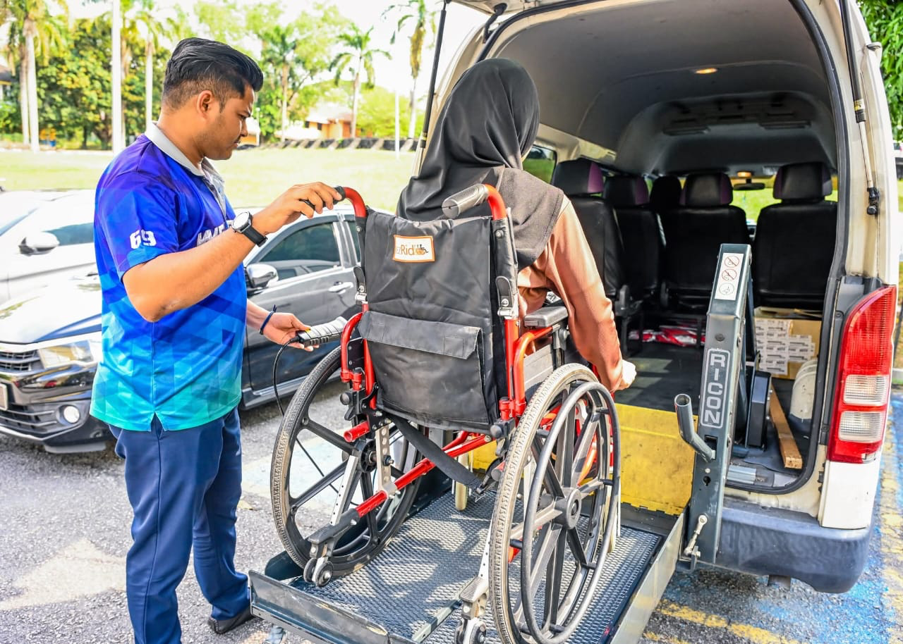
A man operates the wheelchair lift of a van as a wheelchair user boards.
Disability support services in 2025
During 2025 PTOKU USM–MAIK extended its services through the following activities, which together covered rehabilitation, early intervention, mobility, vocational development, entrepreneurship and inclusive education.
Disability support services and activities at PTOKU USM–MAIK in 2025
Date
Disability support service or activity
23 April 2025
Briefing by the Halal Development Corporation (HDC) on business grant opportunities for OKU entrepreneurs in Kelantan; PTOKU USM–MAIK supervises the supported business projects and helps recipients build income and independence.
20 July 2025
Visit by representatives of the Ministry of Finance and MAIK, during which the centre’s rehabilitation and intervention services were highlighted and the proposed Kelantan Autism Centre project, funded through the Kelantan State Ehsan Fund, was reviewed.
27 August 2025
Programme with MAIK presenting wheelchairs, training completion certificates and contributions to persons with disabilities who are asnaf (eligible for zakat assistance) in Kelantan.
22 September 2025
Briefing and tour for a delegation of 45 representatives of the Department of Manpower (JTM), including directors of 33 Advanced Technology Training Centres (ADTEC), who visited the wheelchair modification workshop and the intellectual disability employment simulation laboratory of VT@USM and explored a Train and Place programme, vocational curriculum improvements and wider employment opportunities.
26 October 2025
Visit by the Southeast Asian Ministers of Education Organisation Regional Centre for Special Educational Needs (SEAMEO SEN) to learn about the centre’s empowerment and support programmes and explore collaboration in inclusive and special-needs education.
Through these activities PTOKU USM–MAIK acted as a coordinating platform linking professional expertise, government agencies, industry partners and community organisations to strengthen the participation and independence of persons with disabilities.
USM provides access schemes for students with disabilities that combine mentoring with other targeted support. Targeted support is coordinated by the Welfare, Loan, Scholarship and OKU & First-Generation Student Unit of the Student Development and Alumni Division (BHEPA), which gives students with disabilities access to welfare services and student support and a channel to tell university management directly what they need. Mentoring is delivered through peer programmes run by students.
Targeted support
Students can apply for welfare assistance through the BHEPA Student Welfare Assistance Application Form (updated 27 January 2025), and the University prioritises responsive welfare assistance, efficient and user-friendly counter services and accessible infrastructure so that students with disabilities have equal opportunities to access quality education. The Persons with Disabilities Policy also provides for a dedicated BHEPA unit for persons with disabilities, help with registration with the Department of Social Welfare (JKM) to obtain the OKU allowance, and the appointment of assistants (Sections 3.9, 3.12 and 3.13, PDF pp. 10–11).
Mentoring
Peer mentoring and advocacy for students with disabilities are run through Gerakan Mahasiswa Istimewa USM (Special Students Movement), the P@Ls peer support programme and Sekretariat Insan Istimewa USM (Special Persons Secretariat), which connect students with disabilities to peer mentors in order to build confidence, social inclusion and leadership. Student peers in the OKU Support Group act as “buddies” who help students with disabilities navigate campus life. Read about the PALs programme and the OKU student buddy programme.
What USM did in 2025
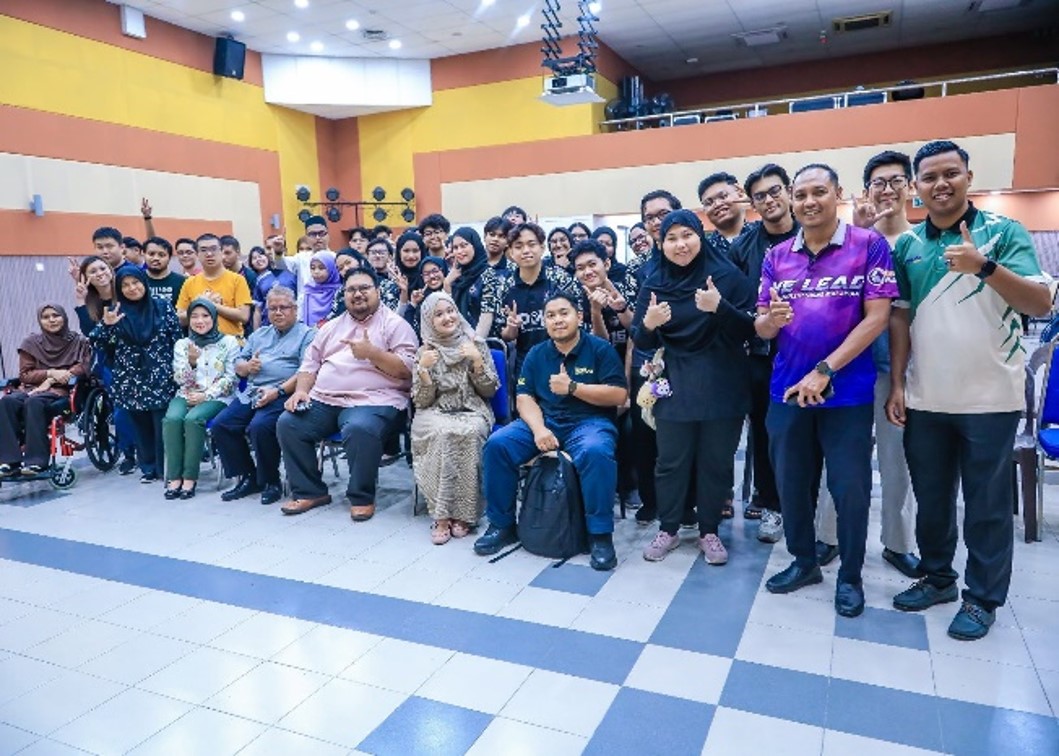
Engagement session with students with disabilities. On 13 December 2025 the Welfare, Loan, Scholarship and OKU & First-Generation Student Unit of BHEPA organised an engagement session at Lantai Seni, KOMCA, Universiti Sains Malaysia, between more than 17 students with disabilities and the Deputy Vice-Chancellor (Student Development and Alumni), Professor Dr Wan Ahmad Jaafar Wan Yahaya. The students gave feedback on physical accessibility and campus facilities, student support services, the inclusive campus experience and the responsiveness of welfare assistance. The Deputy Vice-Chancellor reaffirmed BHEPA’s commitment to quality education, accessible infrastructure, responsive welfare assistance and efficient, user-friendly counter services. Representatives of BHEPA, the Student Representative Council (Majlis Perwakilan Pelajar), Gerakan Mahasiswa Istimewa (GMI) and P@Ls support peers also took part.
Engagement session between students with disabilities and the Deputy Vice-Chancellor (Student Development and Alumni), 13 December 2025.
The session gives students with disabilities a direct line to university leadership and gives the University first-hand feedback that informs improvements to physical facilities, support services and the wider campus experience.
Universiti Sains Malaysia is guided by a framework of institutional
policies that set out the commitments, responsibilities and procedures
through which the University is governed. These policies uphold
institutional integrity, inclusivity, equality and well-being, and
guide the responsible management of the University’s resources and
environment. Explore the policies below for their respective
guidelines and provisions.
Policies & Guidelines
Explore the University’s policies.
01Well-being
USM Anti-Harassment Policy
Sets out the University’s zero-tolerance stance on sexual harassment and how cases are handled.
Commits USM to mainstreaming sustainable development in the core areas of the University, from graduates and research to community engagement and best practices.
Universiti Sains Malaysia publishes its annual SDG reports and its audited financial statements.
01
SDG reports
Universiti Sains Malaysia is committed to publishing a comprehensive report on its activities and programmes related to SDG 1–17 every year. This commitment, and the initiatives it reports, show USM’s contribution to the overall SDG agenda. The reports are listed from the latest year.
SDG Report 2024
Activities and programmes related to SDG 1–17 in 2024.
USM publishes university financial data in its audited financial statements for the year ended 31 December 2025, issued with the Certificate of the Auditor General (Sijil Ketua Audit Negara), which gives the opinion that the statements give a true and fair view. The Statement of Financial Position is on pp. 5–6 and the Statement of Financial Performance on pp. 7–8 of the document.
Summary of financial data for the year ended 31 December 2025 (RM)
Year ended 31 December 2025 (RM)
Group
University
Total revenue
2,036,836,050
1,970,125,326
Total expenses
1,722,689,551
1,661,914,920
Total assets
7,217,654,875
7,109,791,087
Supporting document
Penyata Kewangan Universiti Sains Malaysia, 31 December 2025 (Financial Statements)
Audited financial statements with the Certificate of the Auditor General. Bilingual: Malay and English.