


OUR PLAN TO REDUCE CARBON EMISSIONS
Universiti Sains Malaysia is committed to climate action, aligning institutional policies and operations to address the challenges of climate change. Through the USM Sustainability Policy and the USM Sustainability Action Plan, the University promotes responsible resource management, sustainable education, and collaborative action across all campuses.
USM integrates systematic low-carbon energy tracking to monitor its energy use and support national efforts toward a low-carbon future. The University also advances climate resilience and partnerships by working with communities, local authorities, and knowledge networks to strengthen collective capacity for adaptation and preparedness.
In pursuit of this goal, Kampus Sejahtera USM implements the GreenOffice@USM programme, which encourages sustainable workplace practices such as energy conservation, waste reduction, and environmentally responsible procurement. This initiative nurtures a culture of sustainability within the campus community and reinforces collective responsibility for reducing emissions.
In line with Malaysia’s national aspiration, USM maintains a firm commitment to carbon neutral university status by 2050, reflecting its leadership in sustainability and long-term dedication to reducing environmental impact.
-
Low-Carbon Energy
Measuring and Tracking Low-Carbon Energy Use Across Universiti Sains Malaysia
Universiti Sains Malaysia systematically measures and monitors low-carbon energy consumption across the whole university in alignment with the USM Energy Policy (Revised 2025) and the USM Sustainability Policy (Revised 2025). Both policies emphasize the transition toward renewable energy, the reduction of greenhouse gas (GHG) emissions, and the efficient management of electricity in support of SDG 7 (Affordable and Clean Energy) and SDG 13 (Climate Action).
In 2024, the university tracked its total energy consumption and renewable energy generation through official utility records covering the whole institution. The data show that USM consumed a total of 63,995,989 kWh (equivalent to 230,386 GJ) of electricity across its three campuses, namely the Main Campus, Engineering Campus, and Health Campus. Of this total, 18,259,661 kWh (equivalent to 65,735 GJ) was generated from low-carbon sources, primarily through the Solar Photovoltaic (PV) System under the Net Energy Metering (NEM) scheme. Please refer graph below:
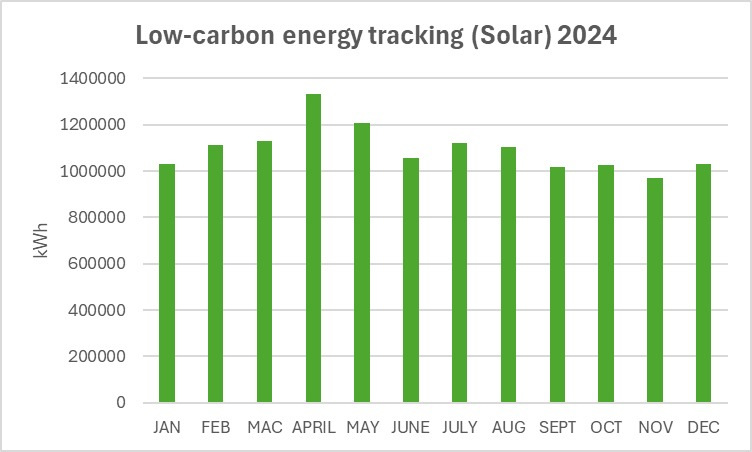
This represents approximately 28.5 percent of total energy use derived from renewable, low-carbon energy across the whole university. The solar PV systems installed at the Main and Engineering Campuses operate under a continuous energy monitoring process that tracks monthly generation and grid imports. The data collection is part of the Energy Saving Measures (ESM) initiative, which ensures compliance with the national energy-efficiency standard MS 1525:2007.
The Development and Facilities Management Department compiles and reports these figures through monthly performance tracking, verifying solar output against total electricity demand. This transparent monitoring mechanism ensures that renewable energy use is accurately accounted for and reported in Gigajoules (GJ).
USM’s ongoing low-carbon energy tracking serves as a foundation for its long-term target to achieve 50 percent renewable energy share by 2050 and move progressively toward carbon neutrality. Through systematic energy measurement, transparent reporting, and strong policy enforcement across the whole university, USM continues to demonstrate institutional leadership in advancing sustainable energy management within higher education.
-
Commitment to Carbon Neutral University
Commitment to Carbon Neutral University
Universiti Sains Malaysia demonstrates a clear institutional commitment to carbon neutral university and has a target date by which it will become carbon neutral, aiming for carbon neutrality by 2050, as stated in the USM Low Carbon Campus Blueprint Implementation Document 2019–2025 (Revised 2024). Page 2 confirms that USM is committed to achieving its 2050 carbon neutral target in line with Malaysia’s commitment. This long-term direction aligns with the Greenhouse Gas (GHG) Protocol and covers Scope 1, 2 and 3 (partial) emissions across the university’s operations.
USM’s transition to a low carbon pathway is supported by a whole system framework across the domains of Energy, Mobility, Waste and Water. Under the Energy Vision on page 4, USM outlines major targets that include reducing energy consumption, increasing renewable energy generation on campus by 75 percent by 2030 and transitioning university vehicles to hybrid technology. These actions support reductions in both Scope 1 and Scope 2 emissions.
Operational strategies listed in the Energy Strategies Table on page 15 include behavioural change initiatives, installation of efficient equipment, compliance with MS 1525:2007 and the expansion of solar photovoltaic systems. These initiatives contribute directly to measurable Scope 2 reductions.
Supporting Scope 3 related reductions are the sustainable mobility initiatives on pages 17 to 20, waste to wealth programmes on pages 22 to 23 and water efficiency actions on pages 24 to 25. These initiatives form part of USM’s partial Scope 3 decarbonisation efforts.
According to the Carbon Footprint Report (2024), USM recorded a 43.45 percent reduction in electricity related carbon emissions compared to 2019, equal to 11,929.30 tCO₂e. This indicates significant progress toward reducing Scope 2 emissions. Continuous monitoring of energy, waste, water and mobility supports transparent reporting and aligns implementation with the GHG Protocol.
USM Carbon Neutrality Roadmap (Aligned with GHG Protocol)
Through these coordinated actions, USM demonstrates a holistic approach to carbon management and reduction, embedding sustainability across all levels of planning, operations, research, and community engagement. The university’s 2050 carbon neutrality target reflects its commitment to long-term climate action in alignment with SDG 7 and SDG 13.

-
Climate Resilience and Partnership





BUILT ENVIRONMENT
In USM, the built environment emphasizes eco-friendly construction, energy-efficient facilities, and green spaces, fostering a sustainable and conducive campus atmosphere.

WATER
USM prioritizes responsible water use and conservation. We employ water-saving technologies and promote conservation practices, engaging the campus community through education and awareness campaigns.

WASTE
USM emphasizes waste minimization and recycling. Our efforts include recycling facilities, awareness campaigns, and collaborations for proper waste management.

ENERGY
USM prioritizes energy sustainability through efficiency and renewable sources. As part of our effort to reduce carbon emissions, we adopt energy-saving tech, lighting, and solar panels.

CLIMATE ACTION
USM is dedicated to climate change mitigation and adaptation. We integrate climate topics into our curriculum, conduct research, and organize awareness campaigns, seminars, and workshops.

HEALTH & WELLBEING
USM prioritizes sustainability through health and well-being initiatives by promoting physical and mental health, offering recreational facilities, and fostering a holistic and sustainable campus community.

BIODIVERSITY & ECOSYSTEM
USM emphasizes biodiversity conservation and ecosystem management in conducting research, collaborating with stakeholders, integrating biodiversity education, and practicing sustainable land use.