


-
Ecosystem Conservation
Food from Aquatic Ecosystems
Universiti Sains Malaysia upholds a strong commitment to environmental stewardship and responsible food sourcing through the USM Sustainability Policy (Revised 2025). The policy ensures that all food derived from aquatic ecosystems and served on campus is sustainably harvested, supporting the long-term preservation of marine and freshwater biodiversity.
As stated in Section 6.5 (pp. 4-5) of the Sustainability Policy, USM mandates that seafood and other aquatic-based food products must originate from environmentally responsible and certified fisheries or aquaculture operations. This provision aims to reduce overharvesting, safeguard aquatic habitats, and promote ethical sourcing across all university-managed and vendor-supplied food services.
The policy also emphasises the sustainable management of aquaculture systems, including best practices for water-quality monitoring, feed control, and minimal use of antibiotics or chemicals to prevent ecosystem degradation. It encourages suppliers and food operators within the campus to align with sustainable seafood guidelines and traceability standards, ensuring transparency from source to consumption.
By integrating sustainable harvesting principles into its operational framework, USM demonstrates its leadership in implementing campus-wide policies that support SDG 14: Life Below Water. This institutional approach not only safeguards aquatic biodiversity but also reinforces the university’s role as a model for responsible consumption and production in higher education.
Sustainably Farmed Food on Campus
Universiti Sains Malaysia has established clear institutional policies to ensure that food served on campus is sustainably farmed, in accordance with the USM Sustainability Policy (Revised 2025). The policy outlines USM’s commitment to responsible food sourcing, environmentally friendly agriculture, and sustainable land management practices that support SDG 15: Life on Land.
As stated in Section 6.4 and Section 6.5 of the Sustainability Policy (pp. 3–5), all food procured or produced within USM, including those from campus cafeterias and vendor supply chains, must adhere to sustainable farming principles. These principles emphasise responsible land use, minimal chemical input, ethical labour practices, and the protection of soil health and biodiversity.
By embedding sustainable farming principles into its procurement and operational systems, USM ensures that its food ecosystem contributes positively to environmental preservation, local economic development, and community well-being. This policy framework strengthens USM’s leadership in advancing sustainable food systems within higher education.
Sustainable Use, Conservation and Restoration of Land
Universiti Sains Malaysia ensures the conservation, restoration, and sustainable use of terrestrial ecosystems associated with the university through its USM Sustainability Policy (Revised 2025). The policy formalises the university’s commitment to protecting forests, landscaped green spaces, and natural landforms within and around its campuses.
As outlined in Section 6.5 (pp. 4-5), the policy prioritises sustainable land management and biodiversity protection. It highlights the importance of safeguarding ecosystems through responsible land use, reforestation, habitat conservation, and the rehabilitation of degraded areas. It also commits the university to adopt environmentally sensitive campus development planning that preserves terrestrial habitats and prevents land degradation.
The policy integrates principles of ecosystem conservation into academic, research, and operational practices. This includes promoting ecological restoration projects, protecting natural vegetation, and ensuring that construction or landscaping activities comply with sustainability guidelines.
Through this institutional policy framework, USM demonstrates a proactive approach to sustainable land stewardship, ensuring that terrestrial ecosystems such as forests, slopes, and dryland areas are managed responsibly and conserved for future generations
Monitoring IUCN and National Conservation Species
Universiti Sains Malaysia has a formal policy in place to identify, monitor, and protect species listed under the IUCN Red List and the National Conservation List Species, as outlined in the USM Sustainability Policy (Revised 2025).
Under Section 6.5 (pp. 4-5), the policy highlights USM’s commitment to conserving biodiversity and protecting terrestrial habitats associated with university operations. It mandates that all land use, development, and research activities consider the protection of flora and fauna, especially those classified as threatened or endangered.
The policy ensures that any project undertaken within USM campuses or affiliated research areas undergoes environmental consideration to prevent harm to protected species and their habitats. This includes ecological monitoring, impact assessments, and habitat restoration where necessary.
By embedding biodiversity protection into its institutional framework, USM demonstrates a strong commitment to environmental stewardship and compliance with both national and international conservation standards.
Alien Species Impact Reduction
Universiti Sains Malaysia has implemented a comprehensive policy to minimise the impact of alien species across its campuses, consistent with the International Union for Conservation of Nature (IUCN) definition, which describes alien species as organisms introduced outside their natural past or present distribution whose introduction and spread may threaten ecosystems, habitats, or native species.
Outlined in Sections 6.4 and 6.5 (pp. 3–5) of the USM Sustainability Policy (Revised 2025), the university’s policy establishes clear measures to prevent, detect, and manage the introduction and spread of invasive non-native species. USM conducts environmental risk assessments for all activities involving biological materials, landscaping, and research projects to ensure that no invasive species are introduced into the ecosystem.
The policy includes preventive regulations that restrict the trade, transport, and planting of non-native species within university-managed areas. It also emphasises early detection and rapid response systems, including monitoring and reporting mechanisms to assess the presence and ecological risks of potential alien species.
Additionally, the policy mandates that all reforestation, restoration, and landscape development efforts prioritise native species to maintain ecological balance, protect biodiversity, and restore degraded habitats. Education and awareness initiatives are also promoted to ensure that staff and students understand the risks associated with alien species and the importance of preserving native ecosystems.
Through this policy, USM reinforces its commitment to conserving biodiversity and protecting terrestrial ecosystems by actively reducing the ecological impact of alien species within all campus environments.
-
Sustainable Land and Aquatic Habitat
Local Biodiversity in Planning and Development
Universiti Sains Malaysia ensures that local biodiversity is fully integrated into all campus planning and development processes through its Trees Policy, which requires the Vice-Chancellor’s approval for any tree cutting or trimming activities. This policy ensures that natural ecosystems are protected and that vegetation is preserved as a core element of campus design and land management.
The policy establishes that nature must be allowed to flourish with minimal human interference. It mandates that no new building projects may proceed unless they occupy the footprint of an existing structure, thereby preventing unnecessary clearing of green areas or loss of biodiversity. This practice embeds ecological preservation into USM’s infrastructure development process and supports a sustainable balance between built and natural environments.
USM also adopts the concepts of “giving back to nature” and “bringing back nature”, where old buildings without historical or architectural significance are demolished and the sites restored as open green spaces. Natural streams that were previously buried underground are being uncovered to restore hydrological balance and enhance the local ecosystem.
These measures are part of USM’s ongoing effort to create a more pedestrian-friendly and ecologically resilient campus, ensuring that biodiversity remains central to all planning and development decisions. This approach reflects the university’s commitment to responsible land stewardship and sustainable campus growth
Policy Commitment to Preventing and Reducing Marine Pollution
Universiti Sains Malaysia through its USM Sustainability Policy (Revised 2025) (Section 6.5 Life Below Water, pp. 4-5), reinforces its commitment to preventing and reducing marine pollution of all kinds, particularly from land-based activities. The policy reflects the university’s dedication to protecting marine and coastal ecosystems by ensuring responsible management of waste, water, and land resources that may affect downstream environments.
USM also implement a marine pollution prevention policy aimed at reducing marine pollution of all kinds, particularly from land-based activities. This includes proper wastewater and runoff management, and adoption of waste minimisation practices in line with Malaysia’s Roadmap Towards Zero Single-Use Plastics. It also emphasises the conservation of aquatic biodiversity through habitat restoration, water-quality protection, and sustainable land-use management within areas linked to marine catchments.
Implementation is supported by continuous monitoring and data collection led by the Centre for Marine and Coastal Studies (CEMACS), which oversees water-quality assessments, coastal stewardship initiatives, and educational outreach. Campus-level awareness campaigns engage students, staff, and local communities in responsible waste disposal and pollution-prevention actions to reduce land-based sources of contamination.
Through these coordinated policy measures and stakeholder engagement programmes, USM ensures that its educational, operational, and research activities contribute to the prevention and reduction of marine pollution, safeguarding aquatic ecosystems for future generations.
Minimising Alteration of Aquatic Ecosystems
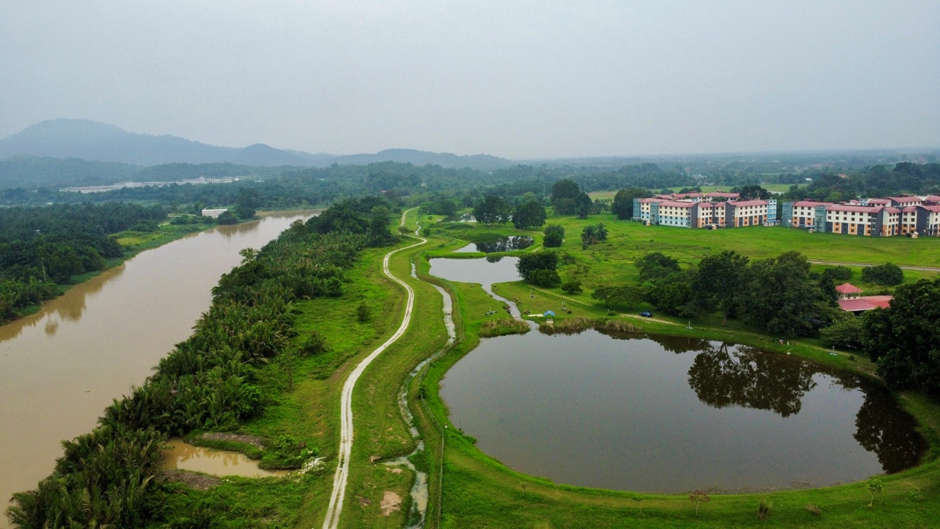
Universiti Sains Malaysia has established a comprehensive plan to minimise physical, chemical, and biological alterations to aquatic ecosystems through the BIOECODS (Bio-Ecological Drainage System) initiative. The system integrates natural and engineered elements designed to restore and maintain ecological balance in urban and watershed environments while managing stormwater sustainably.
The plan focuses on multiple strategies to protect aquatic biodiversity and water quality, particularly within the Kerian River watershed. Key components include:
- Constructed Wetlands: Functioning as biological filters, these wetlands treat stormwater by mimicking natural ecosystems. They trap sediments, filter pollutants, and break down organic matter and nutrients through wetland vegetation and microorganisms, thereby reducing chemical contamination and supporting aquatic biodiversity.
- Ecological Swales: These vegetated channels slow surface runoff, allowing water infiltration and reducing erosion. They also act as natural filters, maintaining the physical and chemical integrity of downstream ecosystems while serving as wildlife corridors for amphibians and invertebrates.
- Detention and Wetponds: These structures temporarily store stormwater, controlling peak flows, preventing flooding, and reducing physical disturbances to aquatic habitats. They also enhance biological treatment through natural sedimentation and nutrient uptake by aquatic plants.
By integrating these components, BIOECODS serves as both a stormwater management system and a biodiversity conservation tool, ensuring that water discharged from urban areas is cleaner and less harmful to aquatic ecosystems. The system operates in accordance with the Urban Stormwater Management Manual for Malaysia (MSMA), which emphasizes source control and sustainable watershed management.
Through BIOECODS, USM demonstrates its commitment to maintaining the ecological integrity of aquatic ecosystems, supporting native species, and reducing the negative environmental impacts of urbanization. This holistic plan positions USM as a national model for sustainable aquatic ecosystem management that balances infrastructure development with ecosystem preservation.
Monitoring the Health of Aquatic Ecosystems
Universiti Sains Malaysia through the Centre for Marine and Coastal Studies (CEMACS), actively monitors the health of aquatic ecosystems to ensure the long-term sustainability of coastal and marine environments. This ongoing monitoring programme covers multiple sites around Penang and the northern Straits of Malacca, including Teluk Aling within Penang National Park, the Middle Bank seagrass bed off the east coast of Penang, and coastal waters around Pulau Jerejak and Batu Uban. These areas represent ecologically significant and sensitive habitats vital for fisheries, biodiversity, and coastal protection.
At each monitoring site, researchers and students collect detailed data on water temperature, salinity, pH, dissolved oxygen, turbidity, nutrients (nitrates, phosphates, ammonia), and phytoplankton composition as key ecological indicators. Monitoring also extends to estuarine and riverine systems connected to Penang’s coastline, acknowledging the influence of land-based activities on marine ecosystem health.
The outputs of these long-term monitoring activities include comprehensive water quality datasets that identify ecological trends, early warning indicators of pollution or algal blooms, and policy-relevant scientific reports used by state and national agencies for environmental impact assessments and marine management planning.
CEMACS also integrates capacity-building and public engagement, training students and local community members in field sampling and data interpretation. This approach not only enhances environmental awareness but ensures that science directly informs conservation actions and sustainable coastal management.
Through these efforts, USM demonstrates a strong institutional commitment to monitoring, conserving, and managing aquatic ecosystem health, supporting evidence-based decision-making for the protection of Malaysia’s marine biodiversity.
Watershed Management Strategy for Aquatic Biodiversity
Universiti Sains Malaysia has implemented a watershed management strategy based on location-specific diversity of aquatic species through the BIOECODS (Bio-Ecological Drainage System) project, an innovative system designed for the Kerian River watershed. This strategy recognises the unique ecological characteristics and aquatic biodiversity of the area, ensuring that stormwater management practices are tailored to the environmental needs of local species and habitats.
The BIOECODS integrates sustainable stormwater management with ecological design to enhance aquatic biodiversity while mitigating urban runoff impacts. The system combines constructed wetlands, detention and wetponds, and ecological swales to create a self-sustaining watershed ecosystem that supports native flora and fauna.
Constructed wetlands are designed to treat stormwater while providing natural habitats for native aquatic species. The selection of local wetland plants enhances water filtration and supplies food and shelter for fish, invertebrates, and other organisms, creating a thriving ecological balance within the Kerian River watershed. Detention and wetponds regulate water flow, prevent flash floods, and stabilise hydrological conditions that support aquatic species survival. Ecological swales function as natural corridors that slow down water flow, promote infiltration, and improve water quality, while offering habitats for amphibians and invertebrates that are vital to the aquatic food web.
This location-specific watershed management strategy ensures that the biological diversity of the Kerian River is integrated into every stage of stormwater design and operation. By aligning with the Urban Stormwater Management Manual for Malaysia (MSMA), the BIOECODS system not only improves water quality but also strengthens the ecological integrity and resilience of local aquatic environments.
Through BIOECODS, USM demonstrates how a university can effectively combine engineering innovation and ecosystem understanding to maintain the health of watersheds and conserve aquatic biodiversity. The model serves as a replicable example of sustainable urban water management that supports both human and ecological well-being.
-
Community Ecosystem Stewardship


BUILT ENVIRONMENT
In USM, the built environment emphasizes eco-friendly construction, energy-efficient facilities, and green spaces, fostering a sustainable and conducive campus atmosphere.

WATER
USM prioritizes responsible water use and conservation. We employ water-saving technologies and promote conservation practices, engaging the campus community through education and awareness campaigns.

WASTE
USM emphasizes waste minimization and recycling. Our efforts include recycling facilities, awareness campaigns, and collaborations for proper waste management.

ENERGY
USM prioritizes energy sustainability through efficiency and renewable sources. As part of our effort to reduce carbon emissions, we adopt energy-saving tech, lighting, and solar panels.

CLIMATE ACTION
USM is dedicated to climate change mitigation and adaptation. We integrate climate topics into our curriculum, conduct research, and organize awareness campaigns, seminars, and workshops.

HEALTH & WELLBEING
USM prioritizes sustainability through health and well-being initiatives by promoting physical and mental health, offering recreational facilities, and fostering a holistic and sustainable campus community.

BIODIVERSITY & ECOSYSTEM
USM emphasizes biodiversity conservation and ecosystem management in conducting research, collaborating with stakeholders, integrating biodiversity education, and practicing sustainable land use.