Explore how Universiti Sains Malaysia opens its heritage buildings, libraries, museums and green spaces to the public, provides affordable housing, builds on brownfield sites and promotes sustainable commuting.
Universiti Sains Malaysia (USM) provides public access to buildings, monuments and natural heritage landscapes of cultural significance, and offers free access to all significant buildings, monuments and heritage landscapes on its Minden campus. The campus occupies the former Minden Barracks, and its historic buildings are not set apart from everyday life: they continue to be used and conserved through adaptive reuse. This keeps old structures in service, reduces the need for new construction, preserves a sense of place and lets visitors see how the site changed from a military barracks into a university.
Visitors can walk freely through the heritage landscape and view every significant building and monument from the outside. The public-facing heritage buildings, the Tuanku Fauziah Museum and Art Gallery, the Galeri Adiwarna and the Archaeology Gallery, are open to visitors free of charge. Inside buildings that also house offices, residences and laboratories, access follows operating hours, office functions and security requirements, and permission from the responsible centre is needed to enter working areas.
Landmarks of the Minden campus
Significant heritage buildings at the USM Minden campus
Building
History and present use
Tuanku Fauziah Museum and Art Gallery
Built in 1938 as a military maternity hospital and British officers’ mess, and later one of the university’s first libraries. The USM Museum was officially opened on 21 January 1982 and renamed the Tuanku Fauziah Museum and Art Gallery on 19 March 2007. Its neoclassical architecture, including Doric columns, makes it a campus heritage landmark.
Red House
Used by military personnel and their families for recreation, receptions and celebrations in the Minden Barracks era. It remains in active use as a campus service space with offices, a photocopy shop and a café.
APEX Hall
Part of the cluster of former residences in the heritage landscape. It now serves in place of the former USM Guest House, preserving the historical identity of the campus while meeting present-day needs.
USM Post Office
Originally the residence of a British officer stationed at Minden Barracks. It has been preserved as an everyday facility with a new function.
School of Languages, Literacies and Translation buildings
Buildings formerly used as British military offices, now used for teaching, research and administration.
School of Chemical Sciences store buildings
Among the earliest structures on the site. USM archival sources state that the original store was built by the British military in 1938 to store ammunition. Its basic structure has been retained and it is now used to store chemicals.
Water Tower
A utility landmark that records the service infrastructure of the Minden site.
Other former residences, guest houses, galleries, schools and recreational facilities, including the swimming pool, its changing room and the Target Theatre, complete the historic landscape of the campus. Locations are mapped by zone on the interactive heritage map.
Visitor information: how to visit
The table below sets out the access arrangements for the heritage buildings that visitors are most likely to enter. For all other buildings, visitors can view the exterior and surroundings freely, as set out in the guidance that follows.
Visitor information for significant heritage buildings
Building (map code)
Public access
Days, hours and arrangements
Information
Tuanku Fauziah Museum and Art Gallery (B01)
Free access to the building, exhibitions and collections
Monday to Friday, 9.00 a.m. to 5.00 p.m. Closed on Sundays and public holidays.
Red House (A04), USM Post Office (C18) and APEX Hall (B04 to B07)
Free to view from outside; public use of the services inside
Open during the operating hours of the offices, shop, café and services they house.
Interactive heritage map
School buildings and stores (D09, D10, D26, D27, H04, H05)
Free to view from outside
Working teaching, research and laboratory buildings. Interior access needs permission from the school or centre concerned.
Interactive heritage map
Water Tower (D08) and Target Theatre (E15)
Free to view from outside
Seen from the open grounds and roads of the campus.
Interactive heritage map
Public guidance
Use the interactive heritage map first. Buildings are grouped in Zones A, B, C, D, E and H, and selecting a map symbol shows the building’s name, photograph and location.
Walking through the heritage landscape and viewing the buildings, monuments and the Water Tower from the outside is free and does not need booking.
Entering working areas such as offices, residences, laboratories and stores follows the operating hours and security requirements of the occupant, and needs permission from the responsible school or centre.
Group visits to the Archaeology Gallery are arranged in advance with CGAR, and visits to the Marine Invertebrate Museum and related collections are booked through the Centre for Marine and Coastal Studies (see section 03).
Heritage map zones
Significant buildings on the heritage map by zone
Zone
Significant buildings and monuments on the map
Zone A
A04 Red House
A05 Swimming Pool Changing Room
A06 Swimming Pool
Zone B
B01 Tuanku Fauziah Museum and Art Gallery
B02 Vice-Chancellor’s Residence
B03 Leader House
B04, B05 and B07 APEX Hall 1, 2 and 3
B06 APEX Hall Office
B08 Bumbledees Cafeteria
B09 Archaeology Gallery
B10 Security Director’s Residence
Zone C
C02 Centre for Research on Women and Gender (KANITA)
C04 Bursary Department
C05 AIDS Action and Research Group
C09 International Mobility and Collaboration Centre
C10 School of Communication
C11 and C12 School of Humanities
C13 and C14 School of Social Sciences
C15 Centre for Co-Curriculum Programmes and Internal Audit Unit
C18 USM Post Office
Zone D
D02 Alumni Development Centre
D03 Centre for Policy Research
D04 ISDEV
D05 CenPRIS
D07 Graduate School of Business
D08 Water Tower
D09 and D10 School of Languages, Literacies and Translation
D12 CIMB Bank Building
D13 School of Communication
D18 Centre for National APEX Development Indicators
D26 and D27 School of the Arts
Zone E
E15 Target Theatre
Zone H
H04 and H05 School of Chemical Sciences stores
H18 and H19 Essential/Technical Staff Quarters
H20 and H24 Student Development Affairs Division
H23 Housing and Accommodation Centre
What USM did in 2025
Heritage building in public use. From 10 July to 30 August 2025 the Tuanku Fauziah Museum and Art Gallery, housed in its 1938 heritage building, hosted the exhibition Echoes of Time, with installation, sculpture, painting and mixed-media works (ArtRabbit listing).
USM provides public access to libraries, including books and publications, with automatic free access for the public to its library reading spaces, a free online catalogue and public membership for borrowing. Anyone can walk into the library reading spaces and read the books and publications on their shelves without registering or paying, and the KRISALIS Online Public Access Catalogue (OPAC) lets anyone search the collections online at no cost.
Free reading spaces
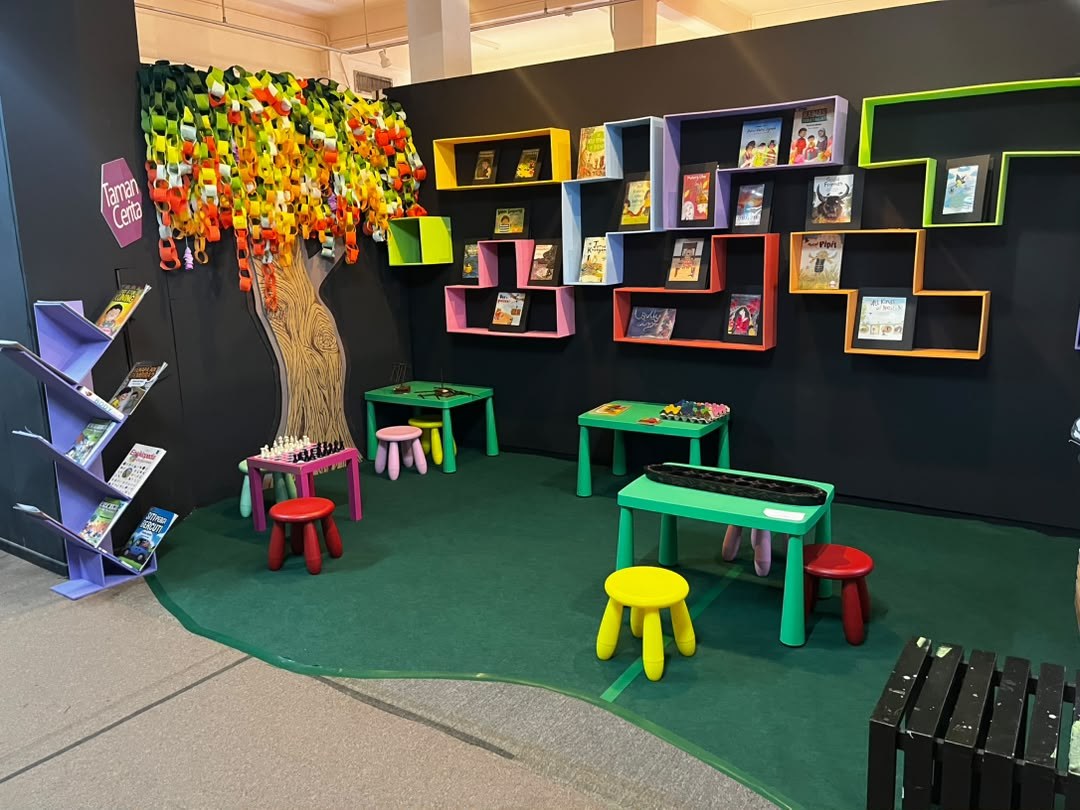
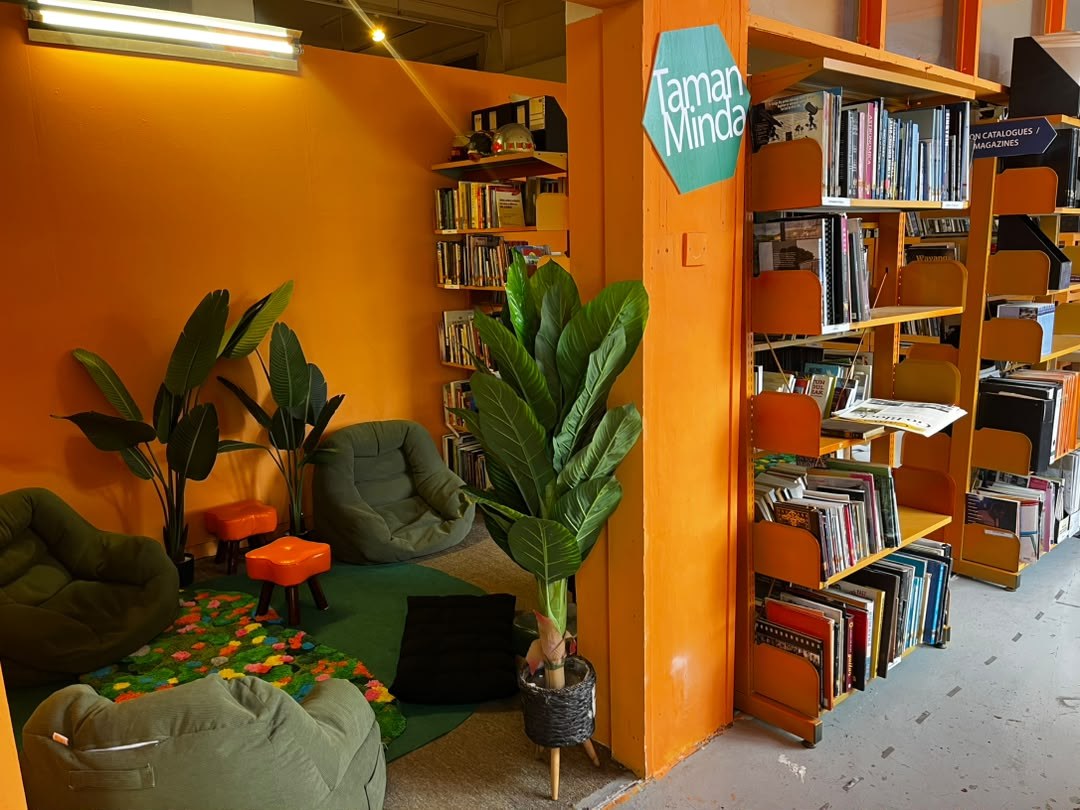
The reading spaces are designed for different readers. Taman Cerita (Story Garden) is a children’s reading space with picture books, low tables and stools, and board games. Taman Minda (Mind Garden) is a quiet reading nook beside the shelves of art catalogues, magazines and books of the art collection. These spaces carry the library’s books and publications to the public directly, and are open to visitors during library hours.
Taman Cerita, the children’s reading space.Taman Minda, the reading nook beside the art collection.
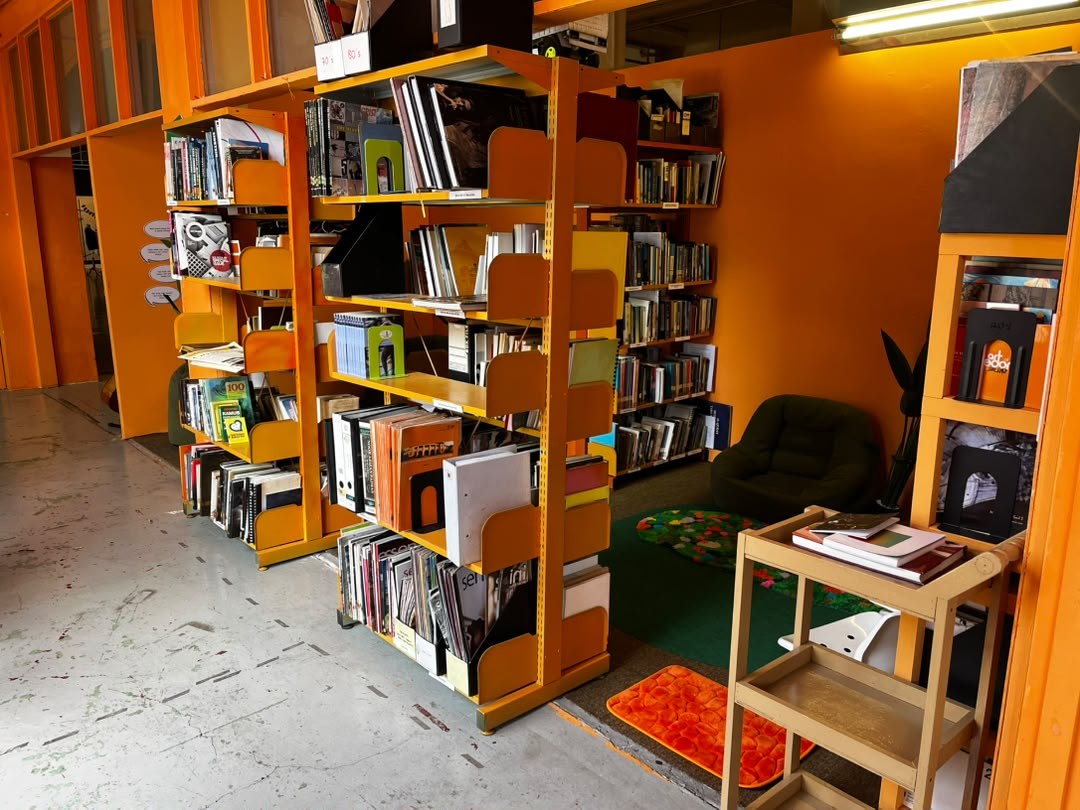
The art collection shelves, open for public reading.
Online catalogue and public membership
KRISALIS OPAC gives free online access to search and locate books, theses, reference materials and other resources held across USM libraries. For borrowing and fuller use, members of the public may register as public members; registered public members use the open-shelf collection, magazines, newspapers, microforms and media materials, and may borrow four books for two weeks. Library services are provided at the Main, Health and Engineering campuses and at the Pusat Kanser Tun Abdullah Ahmad Badawi, according to each library’s operating hours.
Library opening hours
Hours are published by the USM Library for each branch and change during semester breaks and public holidays. The table gives the hours published on the USM Library website (hours page last modified 1 October 2026) for the libraries at the Main Campus and the other campuses.
Published opening hours of USM libraries
Library (campus)
Regular hours
Semester break
Public holidays
Hamzah Sendut 1 (Main Campus, Penang)
Monday to Friday 8.30 a.m. to 9.30 p.m.; Saturday and Sunday 9.00 a.m. to 4.30 p.m.
Monday to Friday 8.30 a.m. to 4.30 p.m.; closed at weekends
Closed
Hamzah Sendut 2 and New Wing (Main Campus, Penang)
Monday to Friday 8.30 a.m. to 4.30 p.m.; closed at weekends
Please refer to the Library hours page
Closed
Musa Mohamad
Monday to Friday 8.30 a.m. to 9.30 p.m.; Saturday and Sunday 8.30 a.m. to 4.30 p.m.
Monday to Friday 8.30 a.m. to 4.30 p.m.; closed at weekends
Closed
Hamdan Tahir (Health Campus, Kelantan)
Sunday to Thursday 8.30 a.m. to 6.00 p.m.; closed on Friday and Saturday
Monday to Friday 8.30 a.m. to 4.30 p.m.; closed at weekends
Closed
Pusat Kanser Tun Abdullah Ahmad Badawi (Bertam, Penang)
Monday to Friday 8.30 a.m. to 5.00 p.m.; closed at weekends
Please refer to the Library hours page
Closed
Enquiries about public access and public membership can be made at the Hamzah Sendut Library help desk, telephone +604-653 3720.
USM provides free public access to museums, exhibition spaces and galleries, including works of art and artefacts, across its schools and research centres. They bring together fine art, ethnography, archaeology and marine biodiversity, and they are open to the public and to the university community alike. The Tuanku Fauziah Museum and Art Gallery, the Galeri Adiwarna and the Archaeology Gallery all offer free access to the public.
Tuanku Fauziah Museum and Art Gallery
The university’s flagship art and heritage museum holds collections of Malaysian fine art, ethnography and cultural artefacts. Admission is free. It is open Monday to Friday, 9.00 a.m. to 5.00 p.m., and closed on Sundays and public holidays. Its Virtual Gallery gives free online access to curated exhibitions from the Ethnography and Fine Art Collections. Visit the museum website.
Galeri Adiwarna, School of the Arts
A dedicated art and design gallery in the main building of the School of the Arts that shows traditional and contemporary works by students, staff and local artists through regular exhibitions and design showcases. Admission is free.
Archaeology Gallery, Centre for Global Archaeological Research
The gallery displays artefacts from USM excavations and research, and visitors can also arrange visits to the Sungai Batu Archaeological Site and the UNESCO World Heritage Site of Lenggong Valley. Admission is free, and visits are arranged in advance with the Centre. Its Virtual Museum gives online access to Malaysia’s earliest civilisations and archaeological discoveries.
Centre for Marine and Coastal Studies
Scheduled educational visits let schools, government agencies, non-governmental organisations and members of the public see the Marine Invertebrate Museum, the Marine Reference Collection Centre and the Biodiversity and Climate Change Interactive Gallery. Visits are booked online or by email at least 14 days ahead. Book a visit.
Visitor information: museums and galleries
Visitor information for USM museums and galleries
Museum or gallery
Public access
Days, hours and arrangements
Contact or booking
Tuanku Fauziah Museum and Art Gallery
Free access to the museum and its exhibitions; free online access to the Virtual Gallery
Monday to Friday, 9.00 a.m. to 5.00 p.m. Closed on Sundays and public holidays.
Marine Invertebrate Museum, Marine Reference Collection Centre and Biodiversity and Climate Change Interactive Gallery, Centre for Marine and Coastal Studies
Scheduled educational visits for schools, government agencies, non-governmental organisations and the public
By prior reservation, at least 14 days before the visit
Exhibitions open to the public in 2025. The Tuanku Fauziah Museum and Art Gallery opened the exhibition H3RO: A Decade of Love and Compassion Across Dimensions, which ran from 1 October 2024 to 31 March 2025, Monday to Friday between 9.00 a.m. and 5.00 p.m., with free admission. From 10 July to 30 August 2025 the museum also hosted the exhibition Echoes of Time, with installation, sculpture, painting and mixed-media works (ArtRabbit listing).
04
Open spaces and green spaces
Guided by its “University in a Garden” concept, USM provides permanent free access to open spaces and green spaces across its campus. Gardens, tree-lined avenues, lakes and outdoor communal areas are open to the public and the university community for nature appreciation, recreation, informal learning and social interaction. They provide shade, reduce local heat, absorb rainwater and support campus biodiversity. Organised group activities and events may need prior approval.
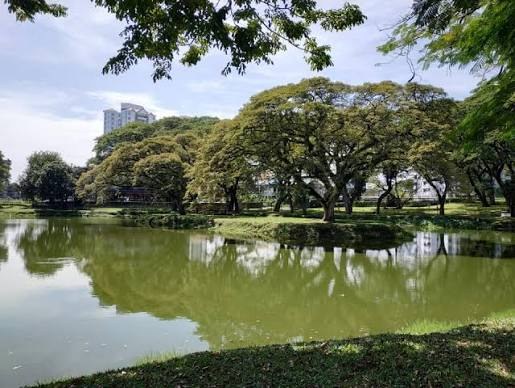
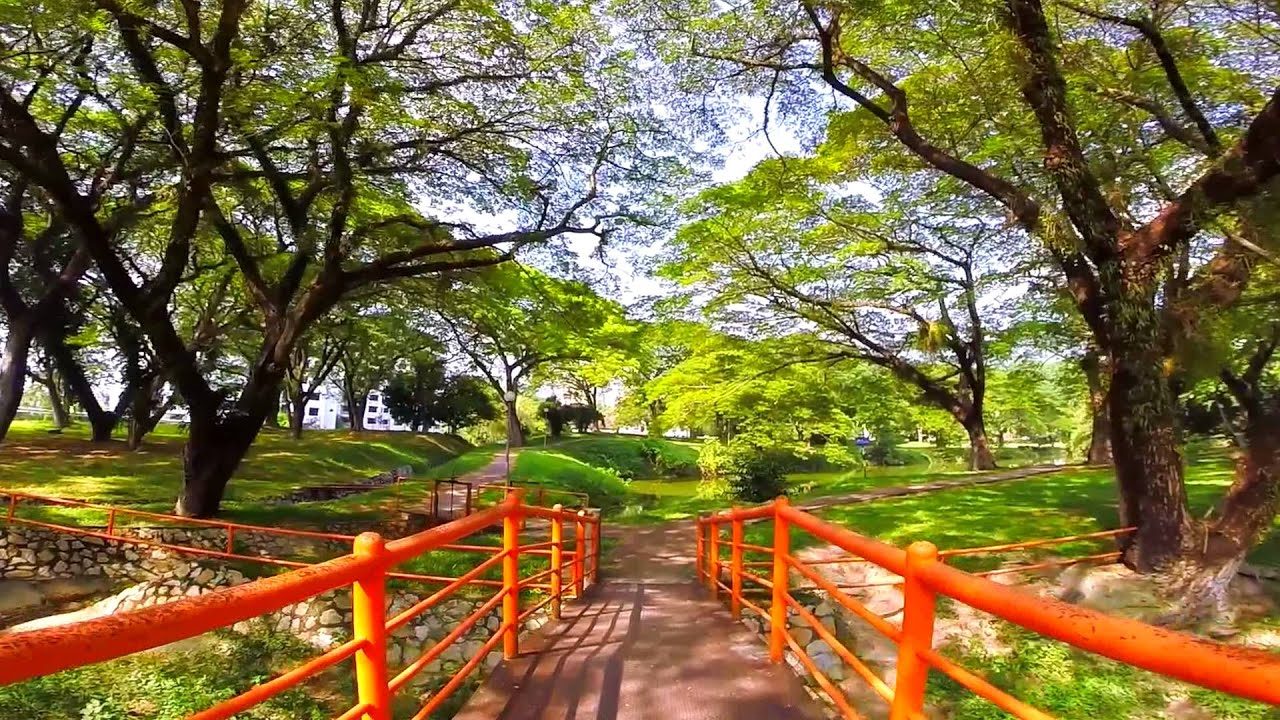
A lake and rain-tree landscape on the campus.
Open spaces and green spaces
ECO-Hub
A space for ecological learning and biodiversity conservation, with campus flora to explore and learning about sustainable ecosystem management. Free ordinary access for the public and the USM community; organised activities may require arrangements.
Aman Lake and Harapan Lake
Tranquil places for relaxation, walking and nature observation. Both also serve as water-retention areas that support stormwater management and provide habitat for aquatic and surrounding wildlife. Free access.
Gardens around academic and cultural buildings
Landscaped areas around the Tuanku Fauziah Museum and Art Gallery, Dewan Budaya, Eureka Complex, School of Educational Studies, School of Distance Education, School of the Arts and the co-curricular facilities give shade and room for informal learning. Free access.
Open spaces around schools and public facilities
Open areas at the School of Humanities, School of Management, School of Housing, Building and Planning, School of Languages, Literacies and Translation, Hamzah Sendut Library 2, USM Press and the Chancellery Complex support walking, rest and informal gatherings. Free access.
Saujana Outdoor Gymnasium
An outdoor exercise space that encourages physical activity, healthy lifestyles and social interaction. Free and open to the public, subject to the facility’s rules.
Multipurpose open grounds
The CONVEX area, the APEX Hall surroundings, the Pharmacy open space and the uniformed units’ parade ground host gatherings, co-curricular activities and events. Free and open to the public; organised events may need permission.
ECO-Hub: a group learning about trees in the campus woodland.The garden in front of Dewan Budaya.Aman Lake: a footbridge and walking path under rain trees.Harapan Lake and its tree-lined banks.
Dewan Budaya and its landscaped forecourt, shaded by a rain tree.
Access conditions
Free ordinary access to these spaces is permanent. It is available to the public and the USM community alike. Organised activities, events and group use may need prior arrangement or approval.
Public access to open spaces and green spaces
Space
Who may visit
Activities
Access conditions
ECO-Hub
Public and USM community
Nature appreciation, ecological observation and environmental learning
Permanent free ordinary access; organised activities may need arrangements
Aman Lake and Harapan Lake
Public and USM community
Nature observation, walking and relaxation
Permanent free ordinary access, subject to campus safety requirements
Gardens around academic and cultural buildings
Public and USM community
Walking, relaxation, outdoor learning and nature appreciation
Permanent free ordinary access to the outdoor areas
Open spaces around schools and public facilities
Public and USM community
Walking, informal gatherings and outdoor learning
Permanent free ordinary access; organised activities may need approval
Saujana Outdoor Gymnasium
Public and USM community
Outdoor exercise and physical recreation
Free access, subject to the facility’s rules
Multipurpose open grounds
Public and USM community, where permitted
Gatherings, training, education and events
Free ordinary access where permitted; organised use may need approval
Open grounds and sports fields on the campus.A group exercise session in an open plaza on the campus.
The interactive map shows 26 campus locations that are open to the public, 12 green-space points and 14 open-space points. Together these spaces show how USM’s landscape serves the wider community as well as the university.
Universiti Sains Malaysia (USM) measures and sets targets for more sustainable commuting through the Mobility section of the USM Sustainability Action Plan 2021–2025 (pages 34 to 39). The plan aims to promote healthy living through sustainable mobility, to support walking, cycling and other lower-carbon ways of travelling, and to make campus roads safer for cyclists and pedestrians. It sets short-term, medium-term and long-term targets for walking, cycling, work from home, electric and autonomous vehicles, and for reducing motor vehicle use.
Policy commitment
The commitment sits in USM’s overarching policy. The USM Sustainability Policy 2014 (Revised 2025), Section 7.3.4 (page 9), commits the university to promote zero waste, zero emission, green and renewable energies in campus development, and Section 7.3.5 commits it to minimise emission, pollution and wastage in university services. The Action Plan (page 21, Energy focus area) lists sustainable mobility initiatives, including hybrid and electric vehicle adoption, improved pedestrian pathways and campus shuttle services, among its practical actions.
Published commuting targets
Sustainable commuting targets in the USM Sustainability Action Plan 2021–2025
Strategy (plan page)
Mode or measure
Short term
Medium term
Long term
1.2 Walking and cycling campaigns and rewards (p. 35)
Share of the university population involved in walking and cycling activities
30% by 2022
50% by 2023
80–90% by 2023
1.3 Car- and motorcycle-free day (p. 36)
Reduction in motor vehicle use during the programme, and in registered motor vehicles
30% reduction
50% reduction
100% reduction during the programme; 30% reduction in registered motor vehicles
1.4 Active mobility day (p. 36)
Increase in rental and refurbished bicycles
30%
50%
70%
1.4 Active mobility day (p. 36)
Increase in walking during office hours
30%
50%
90%
2.1 Work from home (p. 37)
Staff maintaining work from home
30% of staff
—
—
2.2 Infrastructure for walking and cycling (p. 37)
Shaded pathways; bicycle signs and painted bicycle lanes
30% shaded pathways; 30% signs and lanes
Not set
50–70% shaded pathways; 30–70% signs and lanes
2.4 Electric and autonomous vehicles (p. 38)
Awareness of electric and autonomous buses, buggies and bicycles as an alternative mode
10%
30%
70%
3.2 Pedestrian and walking zones (p. 39)
Increase in walking and cycling within identified zones
10–30%
30–50%
50–70%
The plan’s summary of targets (p. XI) also lists a 50% reduction in motor vehicles on campus, a 50% increase in rental and refurbished bicycles, 30% shaded pathways and 30% of staff working remotely by 2023, and vehicle control through traffic control systems by 2025.
How progress is measured
Vehicle registration data, campus mobility surveys and participation tracking in BikeCommute@USM, Dr. Bike and Car-Free Campus Days, which give data on travel modes and participation trends.
Perception surveys before the car- and motorcycle-free day and the work-from-home timetable, to gauge readiness and take-up.
Participation and usage counts against each target, such as the share of the university population taking part in walking and cycling activities and the number of rental and refurbished bicycles.
An audit of pedestrian pathways and potential cycling lanes to measure shaded-pathway coverage and signage.
Analysis of carbon emission reductions from fewer private vehicle entries and bypass vehicles.
Spatial analysis with simulation, modelling and Geographic Information Systems (GIS) to identify pedestrian and walking zones.
Policy document
USM Sustainability Action Plan 2021–2025
The Mobility section, pages 34 to 39, sets out the sustainable commuting strategies and targets summarised above.
USM promotes sustainable commuting through campaigns, student-led activities, public engagement and support for electric mobility, backed by walking, cycling, campus bus and public transport facilities on and around the campus.
Programmes reported in 2025
Green Ride (reported 30 April 2025)
A student-led activity that shows the commitment of USM students to sustainable campus mobility and encourages greener travel choices. USM News report.
Bicycles as Catalysts for Change (20 June 2025)
Bike Commute USM hosted Prof. Leszek Sibilski, who led the movement for World Bicycle Day. His visit included a public lecture, a campus cycling tour, the “Bicycles & the Planet” outreach session for children aged 7 to 12 at SJKC Union, Georgetown, and a 12 km community ride from GSD Bicycle Park to GAMA, officiated by the Mayor of Penang. USM News report.
E-bikes for inclusive mobility (20 November 2025)
USM received a RM30,000 contribution from AFFIN Islamic Bank in the form of 10 electric bicycles for students with disabilities (OKU) from asnaf backgrounds. The Vice-Chancellor officiated the handover at Lantai Seni, Kompleks Cahaya Siswa, hoping the bicycles would help the students move more easily to class, campus activities and daily errands. USM News report.
Sustainable Mobility Week 2025 (from 16 December 2025)
Bike Commute USM (BCUSM), with Rapid Penang, the School of Communication and the School of Social Sciences, ran a three-day awareness week at the DK Foyer to promote walking, cycling and public transport and to reduce reliance on private motor vehicles. Students exhibited work on sustainability and community wellbeing, including “Less Car, More Life”, and a Rapid Penang booth offered Pas Mutiara registration to students and staff. More than 200 visitors attended the BCUSM and Rapid Penang booths. USM News report.
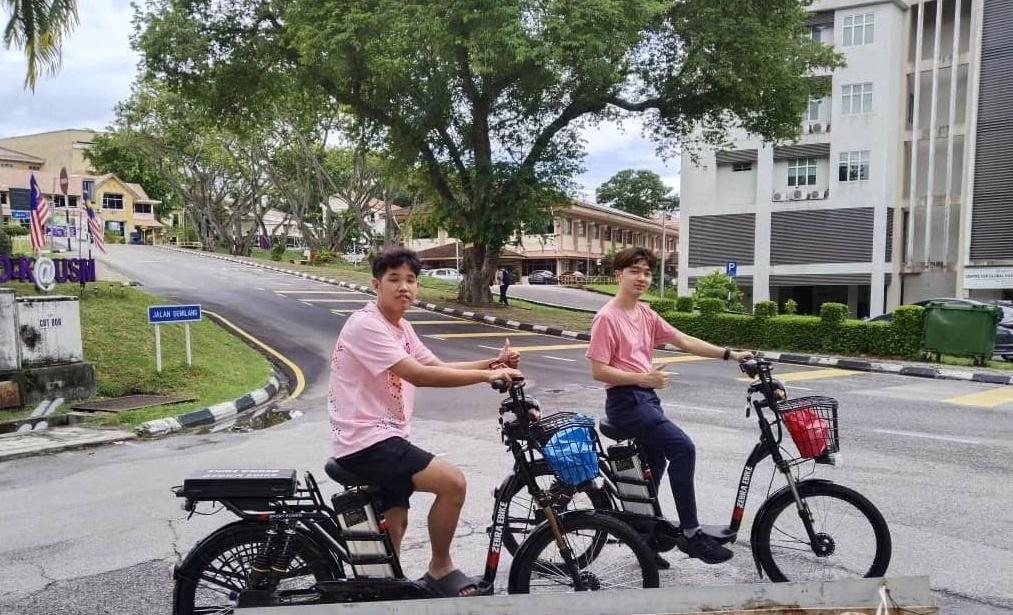
Prof. Leszek Sibilski presenting “Bike & Earth: Teaching Kids Sustainable Transport through Cycling” during his June 2025 visit.The opening of a campus cycling activity.Students cycling along a campus road.Students riding electric bicycles on campus.
The handover of electric bicycles for students with disabilities from asnaf backgrounds, 20 November 2025.An exhibition booth at Sustainable Mobility Week 2025.
Campus bus services
USM operates its own campus bus service, which includes two electric (EV) buses that run daily, and is connected to the Rapid Penang public bus network. Buses let students and staff travel between residential colleges, lecture halls, libraries and the mosque without a private vehicle.
Two electric buses
USM operates two electric (EV) buses, and both run daily on the campus.
Campus Route A
A loop route on the Main Campus serving ten stops: Aman Damai, Jabatan Keselamatan (School of Pharmaceutical Sciences), Stor Kimia (DK G–W), Pusat Sejahtera, Dewan Kuliah SK (School of Social Sciences), School of Languages, Literacies and Translation, School of Housing, Building and Planning (DK D, E, F), Hamzah Sendut 2 (SOM and PPIP), Eureka (Masjid Al-Malik Khalid), and Fajar Harapan (Schools of Biological Sciences and Chemical Sciences), before returning to Aman Damai.
Rapid Penang route T310
Links the USM campus (Padang Kawad, Persiaran Sains, Jalan Mahasiswa, Lengkok Sastera and Jalan Universiti) with Jalan Sungai Dua, Taman Pantai Jerejak, Queensbay Mall, Sungai Nibong, Kompleks Bukit Jambul and Taman Bukit Jambul. It runs daily from 6.00 a.m. to 10.30 p.m., every 20 to 30 minutes, and works with the Pas Mutiara My50 and Pas OKU travel cards.
Tracking the bus in real time
The USM Locator shows where the campus buses are, so riders can plan their journey and wait at the stop only when the bus is close. Open the USM Locator.
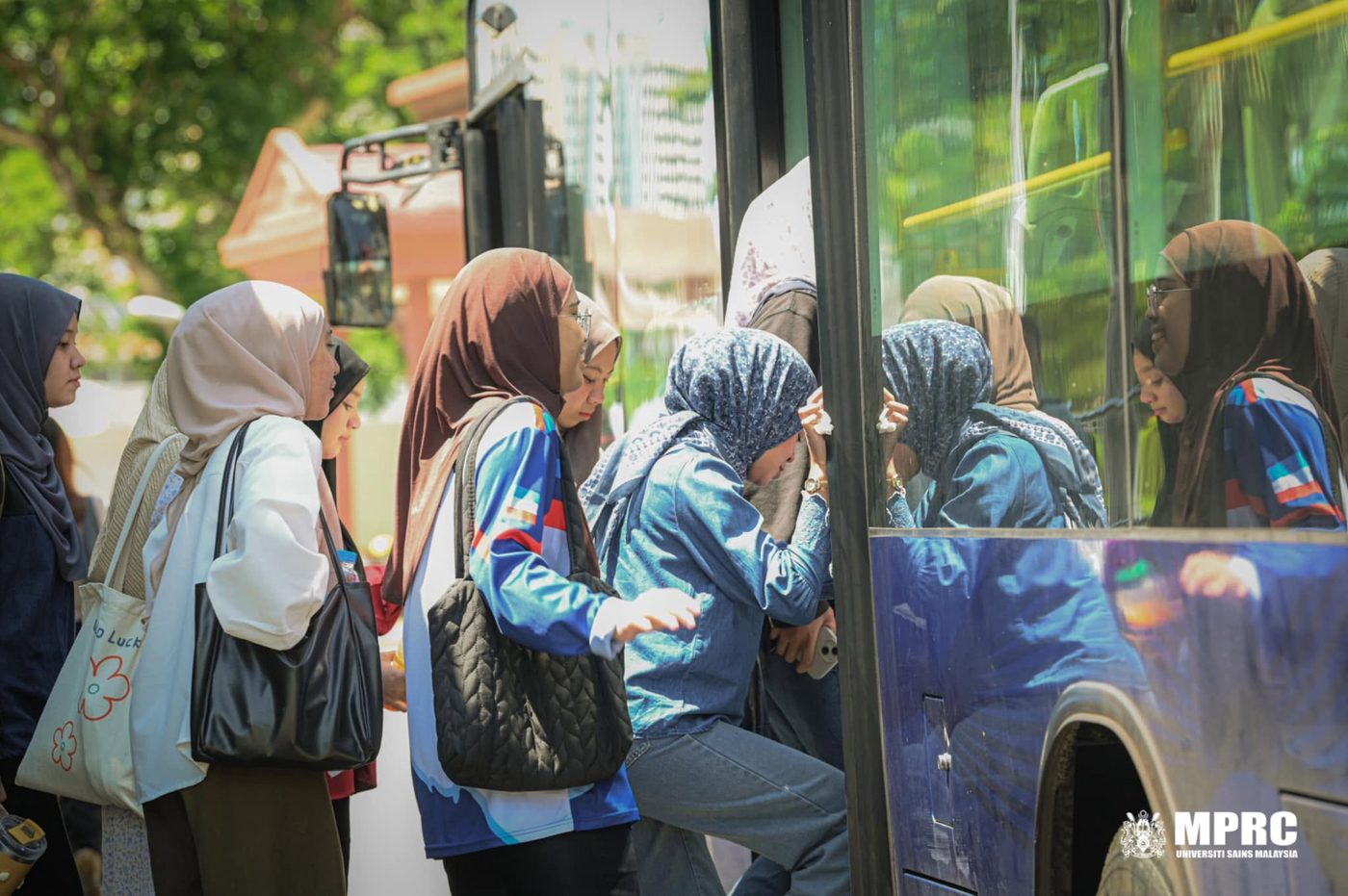
Students boarding a USM campus bus.
Electric and shared mobility
USM also supports electric and shared ways of travelling on the Main Campus, including options that users with disabilities can use:
Electric bicycle rental
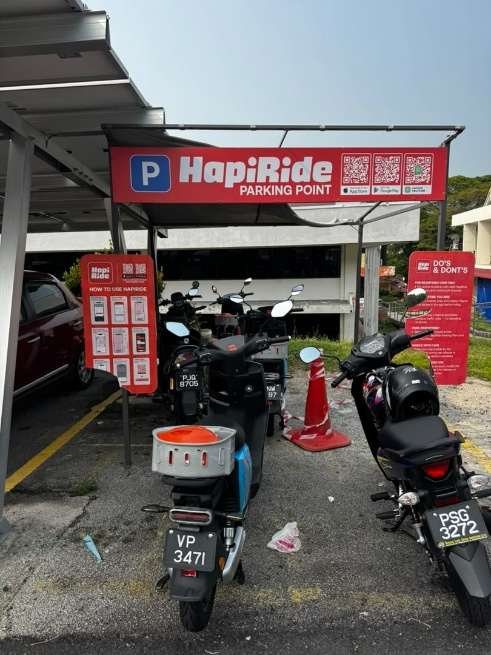
Electric bicycles can be rented and used on the Main Campus from HapiRide parking points.
Beam e-scooters
Beam electric scooters are available at designated locations on the Main Campus as part of the bike-sharing programme.
Bicycle parking and rental
Bicycle parking and rental bicycles are provided on the Main Campus, and bicycle lanes are marked on campus roads.
An electric shuttle bus on the Main Campus.A USM shuttle bus at a stop on the Main Campus.A HapiRide parking point for rented electric bicycles.A student riding a rented electric bicycle on campus.Beam e-scooters at a designated location.Bicycle parking and rental bicycles.A marked bicycle lane on a Main Campus road.
Campus bus Route A (Laluan Bas USM Induk).
Facilities and services that support sustainable commuting
Facilities and services that support sustainable commuting at USM
Mode
Facility or service
Walking
Pedestrian walkways and covered pathways connect campus destinations.
Cycling
Bicycle parking and rental bicycles, and marked bicycle lanes on campus roads.
Campus bus
Free and subsidised shuttle bus services on the Main Campus, including Route A and two electric (EV) buses that run daily, with real-time bus tracking through the USM Locator.
Public transport
Rapid Penang route T310, launched on 6 May 2024, links USM with Bukit Jambul and Queensbay and runs daily from 6.00 a.m. to 10.30 p.m. It works with the Pas Mutiara My50 and Pas OKU travel cards.
Electric mobility
Two electric (EV) buses that run daily, rented electric bicycles and Beam e-scooters on the Main Campus, and the e-bike support for students above.
USM promotes and allows telecommuting and remote working for employees as a matter of policy and standard practice, which reduces the need for staff to commute. The policy basis is the national Public Service Human Resource Circular (Pekeliling Perkhidmatan Sumber Manusia, PPSM) Waktu Bekerja Version 1.0 (2024), Section SR.4.1.2, the Work-From-Home Policy (Dasar Bekerja Dari Rumah), which USM adopts. The section begins on page 26 of the circular and took effect on 1 December 2024.
What the policy provides
Provisions of PPSM Waktu Bekerja 2024, Section SR.4.1.2
Paragraph
Provision
1
Implements the Government’s decision on the Work-From-Home policy.
7
Allows officers to carry out their regular duties or other official tasks from home, for a full day or half a day on working days.
8
Work from home takes place with the approval of the Head of Department, following an application.
11
Work from home must not reduce the quality of service delivery, and the Head of Department monitors the tasks assigned.
15
The policy takes effect on 1 December 2024.
How USM puts it into practice
Flexible Work Attendance System (SKKF)
Staff record their attendance and document official tasks through the Sistem Kehadiran Kerja Fleksi (SKKF) on the Passport USM platform, and supervisors verify submissions digitally, which keeps accountability and performance monitoring in place.
Registry Circular No. 58 of 2025
On 17 November 2025, USM issued Registry Circular No. 58 of 2025 announcing improvements to SKKF. Staff working outside their station, including fieldwork, can record attendance and duty status periodically through the system and update their records when the type of duty or the dates of work outside the station change. Registry announcement No. 58 of 2025 (PDF).
Tools for working anywhere
Staff receive official Microsoft Teams and Webex accounts for virtual meetings and cross-campus collaboration. eLearn@USM and Panopto let lecturers conduct, record and manage courses remotely, and E-Cuti and FIS@USM allow leave applications and financial transactions to be completed digitally from any location.
The USM Sustainability Action Plan 2021–2025 (Strategy 2.1, p. 37) also sets a target for 30% of staff to maintain work from home, as shown in section 01.
Policy document
PPSM Waktu Bekerja Version 1.0 (2024)
Section SR.4.1.2, the Work-From-Home Policy, begins on page 26.
At USM, walking is part of everyday campus life. Guided by the University in a Garden philosophy, the university prioritises pedestrian access as a practical, healthy and environmentally responsible way to move between learning spaces, workplaces, residential areas and shared facilities.
Pedestrian priority in campus planning
The USM Sustainability Action Plan 2021–2025 builds pedestrian priority into its mobility strategies:
Pedestrian and walking zones (Strategy 3.2, p. 39). The plan identifies pedestrian and walking zones through spatial analysis, including simulation, modelling and GIS, and identifies traffic circulation that supports car-free days.
Pathways (Strategy 2.2, p. 37). The plan audits pedestrian pathways and potential cycling lanes and expands shaded pathways, with 30% shaded pathways as the short-term target.
Pedestrian days (Strategy 1.4, p. 36). Bike and pedestrian days replace motor vehicle trips, with targets to increase walking during office hours.
Car- and motorcycle-free days (Strategy 1.3, p. 36). A monthly car- and motorcycle-free day or hour gives priority to people on foot.
The targets for these strategies are listed in section 01. Walking routes connect with campus destinations, shuttle services and public transport, so a journey can combine walking with other transport options.
Covered walkways and pedestrian infrastructure
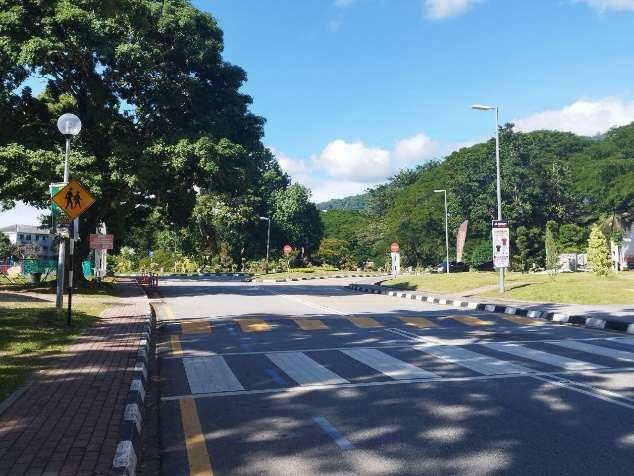
Pedestrian routes link key academic, residential and administrative zones on all campuses. Covered walkways give shelter from sun and rain, and the walkways include tactile guiding paving for visually impaired users. Traffic management measures restrict motor vehicle access in high foot-traffic areas, and the plan sets a long-term target of 100% awareness of traffic and safety rules (Strategy 3.1, p. 39).
Pedestrian infrastructure on USM campuses
Feature
Description
Covered walkways
Roofed walkways on the Main Campus, the Engineering Campus (Nibong Tebal) and the Health Campus (Kubang Kerian).
Designated crossings
Marked pedestrian crossings on campus roads, with warning signs for drivers.
Connected footpaths
Connected footpaths link academic, residential and administrative zones.
Signage and green corridors
Clearly marked signage and green corridors improve comfort, safety and navigation.
Vehicle restrictions
Motor vehicle access is restricted in high foot-traffic areas, for example by no-motorcycle signs beside walkways.
Engineering Campus covered walkway network
Length of covered walkways and pedestrian routes at the Engineering Campus
A covered walkway with tactile paving, Engineering Campus.A covered walkway and crossing, Health Campus (Kubang Kerian).A covered walkway on the Main Campus, Penang.A marked pedestrian crossing on a Main Campus road.
A shaded, brick-paved pedestrian walkway on the campus.
What USM did in 2025
Walking together in 2025. Three activities in 2025 made use of campus walking routes and outdoor spaces.
Walk & Talk Therapy, 18 September 2025
During USM Sustainability Week, the Institutional Planning and Strategic Centre (IPSC) organised a one-hour campus walk linking IPSC, ECO Hub, Rumah Tetamu and Anjung Jannatun before returning to IPSC. IPSC report.
Brisk Walk & Plogging at BIOECODS, 25 August 2025
At the Engineering Campus, the River Engineering and Urban Drainage Research Centre (REDAC) organised a brisk walk and plogging activity around the Bio-Ecological Drainage System (BIOECODS), combining exercise with litter collection. Engineering Campus report.
Walk with Dean, 29 October 2025
The School of Medical Sciences held “Walk with Dean: Brisk Walk & Plogging” at the Sports Complex 2 Field, USM Health Campus, during PPSP Sustainability Week. School of Medical Sciences report.
01
Affordable housing for employees
Universiti Sains Malaysia (USM) provides affordable housing for employees. The Housing and Accommodation Centre (HAC, Pusat Perumahan dan Penginapan Universiti) coordinates university-managed staff housing, on-campus residential quarters for designated personnel and temporary accommodation for academic staff, at rents published by the university. This section sets out the three elements THE Sustainability Impact Ratings assess under the existence of affordable housing: evaluating affordability, providing housing directly and providing financial support.
Evaluating affordability
USM evaluates the affordability of staff housing by publishing the monthly rent of each housing type and comparing it with national household income. Published rents for staff housing range from RM200 to RM350 per month at the Health Campus, and from RM350 to RM450 per month for temporary accommodation for academic staff. For reference, the Department of Statistics Malaysia (DOSM) Household Income Survey 2024 reports a national median monthly household income of RM7,017 and a Pulau Pinang median of RM7,386. Against the national median, a monthly rent of RM200 to RM350 equals about 2.9% to 5.0% of household income.
Staff housing rents compared with the DOSM median household income
Housing
Published monthly rent
Share of the national median household income (RM7,017)
Health Campus single-storey terrace house (Pasir Tumboh)
RM200
about 2.9%
Health Campus double-storey terrace house (Pengkalan Chepa)
RM260
about 3.7%
Health Campus double-storey terrace house (Pasir Tumboh)
RM300
about 4.3%
Health Campus single-storey bungalow (Pasir Tumboh)
RM350
about 5.0%
The comparison uses the national median household income published by DOSM. It is shown to evaluate affordability against a national benchmark and is not a statement of any individual employee’s income. Source: DOSM, Household Income Survey Report, Malaysia and States, 2024 (released 8 October 2025). For comparison, a house for rent outside the university is advertised at about RM2,200 per month in the private rental market.
Providing housing directly
USM provides housing directly through university-owned accommodation that eligible employees rent from the university.
Staff housing at the Health Campus, Kelantan
Terrace houses and bungalows at Pasir Tumboh and Pengkalan Chepa, listed with the number of units and the monthly rent for each type (table below).
On-campus quarters for designated personnel
At the Main Campus, accommodation is available for selected on-call personnel, including medical and security officers, and for Penggawa and Penolong Penggawa responsible for residential college welfare and management, subject to eligibility and approval.
Temporary accommodation for academic staff
Temporary residential units for academic employees taking part in the Rancangan Latihan Kakitangan Akademik (RLKA). The published standard period is six months, with extensions subject to approval.
Staff housing on the Main Campus
The HAC lists staff housing as accommodation for university employees who are relocating to the area to live and work on campus.
Health Campus staff housing
The official staff housing information lists 110 residential units at the Health Campus. These published figures do not establish current occupancy or availability.
On-campus housing for designated university personnel
Housing information
Details
Eligible employees
Designated on-call personnel, Penggawa and Penolong Penggawa
Location
USM Main Campus
Purpose
Operational duties, emergency response and student welfare
Arrangement
University-managed residential quarters, subject to eligibility and approval
A USM staff vacancy announcement dated March 2025 specified an on-campus residence for appointed assistant residential college wardens at RM200 monthly rent, together with an RM300 monthly allowance and specified utility support. Source: 2025 USM staff appointment announcement (PDF).
Temporary accommodation for academic staff
Temporary accommodation rents for academic staff taking part in RLKA
USM supports employees’ housing costs financially in the following ways.
Financial support for employee housing
Support
Description
Rents set and published by the university
University-managed accommodation is let at the published rents above.
Housing support for appointed assistant residential college wardens
A monthly rent of RM200 for on-campus residence, an RM300 monthly allowance and specified utility support, as stated in the March 2025 vacancy announcement.
Employees can obtain current rates, eligibility and application procedures from the HAC.
Housing and Accommodation Centre
The Housing and Accommodation Centre coordinates accommodation services for students and staff. Address: Aras 1, Bangunan H23, Kompleks Cahaya Siswa, Bahagian Hal Ehwal Pembangunan Pelajar & Alumni, Universiti Sains Malaysia, 11800 USM, Pulau Pinang. Telephone: 604-653 4459 / 4456.
USM provides affordable housing for students through its residential colleges, known as Desasiswa, on the Main Campus in Penang, the Engineering Campus in Nibong Tebal and the Health Campus in Kelantan. The Housing and Accommodation Centre (HAC), under the Division of Student Development and Alumni Affairs, publishes the room types and rates. This section sets out the three elements assessed under the existence of affordable housing: evaluating affordability, providing housing directly and providing financial support.
Desasiswa Bakti Fajar Permai, Main Campus.
Evaluating affordability
USM evaluates the affordability of student housing by publishing a fixed daily and per-semester rate for each room type, and by charging students a rate well below the rate for non-students. The Main Campus Desasiswa pages publish RM5 per day for a twin-sharing room and RM6 per day for a single room, which is RM675 and RM810 per semester. At the Engineering Campus, the HAC publishes a postgraduate rate of RM5 per day for a double room and RM6 per day for a single room, against a non-student rate of RM20 per day for a double room and RM40 per day for a single room. The student rate is therefore 25% of the non-student rate for a double room and 15% for a single room. For comparison, a room for rent in the private market near the Main Campus is advertised at about RM690 per month. At the Desasiswa rate of RM5 per day, a 30-day month costs RM150.
Published student accommodation rates
Desasiswa or campus
Room type
Rate per day
Rate per semester
Aman Damai (Main Campus)
Twin-sharing room
RM5
RM675
Aman Damai (Main Campus)
Single room
RM6
RM810
Cahaya Gemilang Harapan (Main Campus)
Twin-sharing room
RM5
RM675
Cahaya Gemilang Harapan (Main Campus)
Single room
RM6
RM810
Engineering Campus, postgraduate students
Double room
RM5
—
Engineering Campus, postgraduate students
Single room
RM6
—
Engineering Campus, non-student rate (applicants with a USM offer letter but no registration, where rooms are vacant)
USM provides housing directly through university-owned and university-managed residential colleges. All registered USM students are eligible to seek accommodation, subject to the availability of rooms. First-year undergraduate students at the Engineering Campus are placed automatically in Desasiswa, and postgraduate students can stay for their entire period of study. Undergraduate accommodation is offered on an annual basis.
Main Campus, Penang
Eight residential colleges are listed by the HAC: Aman Damai, Bakti Fajar Permai and Petas (for postgraduate students), Premium Accommodation (F26), Cahaya Gemilang Harapan, Indah Kembara, Restu, Saujana and Tekun.
Engineering Campus, Nibong Tebal
Desasiswa Jaya (male students), Lembaran (female students) and Utama (an apartment-style hostel for postgraduate and international male students). Rooms are furnished with a bed, study desk, study lamp, wardrobe, electricity and internet.
Shared facilities
Engineering Campus facilities include a sick bay, prayer rooms, pantry, common room, laundry areas, Wi-Fi throughout the hostels, bicycle facilities, a convenience store and a cafeteria.
Desasiswa residential blocks, Main Campus.Student engagement session, USM Bahagian Hal Ehwal Pembangunan Pelajar & Alumni (BHEPA).
Accessible accommodation
The HAC lists a special accommodation Desasiswa: Aman Damai caters to students with special abilities (PKU). The Division of Student Development and Alumni Affairs (BHEPA) engaged students with disabilities in May 2025, and the report is available at BHEPA, student engagement with students with disabilities.
Providing financial support
USM supports students who face financial difficulty through the SULUNG 3.0 Student Development Programme, the Student Welfare Fund and the USM Zakat Fund. In September 2024 the Vice-Chancellor announced that incoming students from low-income families could register at USM without payment through SULUNG 3.0 and pay their fees in instalments. Hostel rent is paid through the USM ePayment portal. New Straits Times, 19 September 2024. USM also channels eKASIH assistance to students: the USM Health Campus news report “21 pelajar terima manfaat program bantuan eKASIH”, reported from USM Kubang Kerian, Kelantan, on 16 January 2025, is available at USM Health Campus news.
Accommodation information and student services
Students can obtain guidance on services and placement from the HAC. At the Engineering Campus, the HAC office opens Monday to Friday, 8.10 a.m. to 5.10 p.m., excluding public holidays. Main Campus HAC telephone: 604-653 4459 / 4456. Hostel rental payment guide (May 2025): USM ePayment hostel rental payment guide (PDF).
Universiti Sains Malaysia (USM) promotes responsible land use by prioritising the refurbishment, adaptation and reuse of previously developed sites wherever practicable. This is especially important at its established Main Campus in Penang, where academic facilities, residences and infrastructure share limited space with valuable landscaped areas. Reusing existing buildings can accommodate changing university needs while reducing pressure to develop green spaces.
In line with the THE Sustainability Impact Rating definition, a brownfield site is previously developed land or a building that is currently underused or unused. USM applies this to existing buildings whose original function has ended, as the project below shows.
USM’s wider campus network, including the Engineering Campus in Nibong Tebal, the Health Campus in Kelantan and the Advanced Medical and Dental Institute in Bertam, provides different settings for future infrastructure planning. Development at every location must consider its existing land use, operational requirements and environmental safeguards.
The USM Energy Policy (Revised 2025) requires energy-efficiency considerations in renovations as well as in new buildings. Together with USM’s commitment to responsible land management, this supports a practical approach to campus development: assess the potential of existing facilities first, adapt spaces to changing functions, and preserve green areas where possible.
The main brownfield project is the conversion of the former Matriculation Centre, Building No. 88 (map code D33), into the Graduate School of Business. The building is previously developed land with a long history of use. It was first used as a male student hostel, was then adapted for School of Chemical Sciences use, and later served as USM’s Matriculation Centre. From May 2000, the implementation of the Matriculation Science Programme was taken over by the Ministry of Education, and the building’s role as the Matriculation Centre ended. USM has refurbished the existing building for a new academic purpose instead of building on undeveloped land, and no new land was cleared for the Graduate School of Business.
The history of the former Matriculation Centre, Building No. 88 (D33), shown with archive photographs of the building.
The photographs below show the existing building during refurbishment and after its conversion. The refurbishment kept the original building, so no land was cleared, and gave it a new use as the home of the Graduate School of Business.
The existing building during refurbishment.Refurbishment works continuing on the building.The refurbished building, now the USM Graduate School of Business.
Brownfield reuse is also how USM meets everyday space needs. Official USM procurement notices issued in 2025 show that the university continued to plan improvements within existing Main Campus buildings rather than on new sites.
Building G03
Proposed upgrading of tutorial rooms.
Building C04, Treasurer’s Department
Proposed alteration works to the upper floor.
Building D01, Alumni facility (Anjung Budi)
Proposed additions and upgrading.
These proposals reflect an approach to meeting institutional needs through existing developed sites: to assess the potential of existing facilities first, adapt them to changing functions and preserve green areas where possible.