


-
Educational Equity
Expanding Access for Low-Income Students
Universiti Sains Malaysia has implemented a targeted admission strategy to enhance access to higher education for students from financially disadvantaged backgrounds. This policy specifically targets the admission of students who fall into the bottom 20% of household income group in the country, representing a more tightly defined group within Malaysia’s national bottom 40% (B40) category.
The initiative reflects USM’s strong commitment to promoting social mobility and inclusive education through financial equity and accessibility. In alignment with the Malaysia Education Blueprint (Higher Education) 2015–2025 (pp. 64–67), which serves as the guiding national policy for equitable access and inclusivity, USM ensures that admission opportunities remain open to under-represented groups, including students from the B40 community, indigenous backgrounds, senior citizens, athletes, and persons with disabilities.
In the 2024/2025 academic session, 1,500 B40 students were admitted through the UPU channel, representing 31.2% of all new undergraduate enrolments (USM News Portal, 5 Oct 2024). This milestone demonstrates USM’s proactive role in expanding access to higher education and advancing the national agenda for inclusive and sustainable education.
Empowering Student Success Through Equity
Universiti Sains Malaysia is deeply committed to promoting graduation and completion targets for students who fall into the bottom 20% of household income group (or a more tightly defined target) in the country, defined nationally as the B40 category. This focus reflects USM’s strategic efforts to ensure that socioeconomic status does not impede academic success, in line with the Malaysia Education Blueprint (Higher Education) 2015–2025 (pp. 64–67), which emphasizes equitable access, retention, and completion across all income levels.
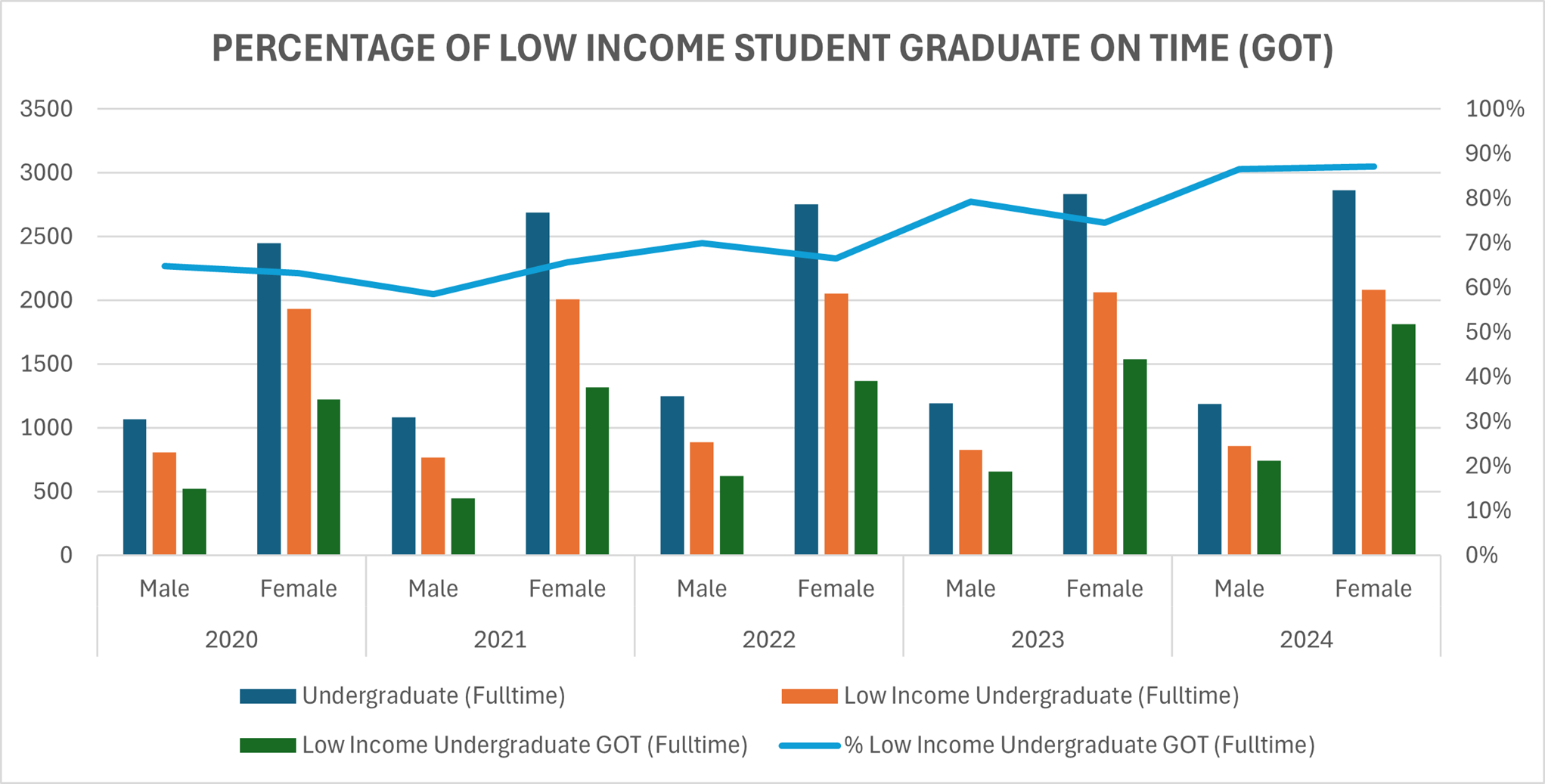
Between 2020 and 2024, USM strengthened support for financially disadvantaged students through targeted financial aid, academic counselling, and dedicated learning resources to promote timely graduation. The university closely monitors academic performance and completion trends for this group to maintain accountability in delivering inclusive education outcomes.
The results illustrate significant progress. In 2020, 63.7% of B40 students graduated on time, and by 2024, this rate had risen to 87%, demonstrating the university’s success in improving academic attainment among low-income students. Through these initiatives, USM continues to bridge economic disparities, empower students from vulnerable backgrounds, and uphold education as a pathway to social mobility and transformation.
Low-Income Student Support
Universiti Sains Malaysia recognises that financial hardship can affect a student’s ability to thrive and complete their studies. To remove these barriers, USM provides a comprehensive range of free support services that enable students from low-income families to focus on academic achievement and overall well-being.
Among the key services are free campus shuttle transportation, the USM Food Bank, which ensures daily access to nutritious meals, and free legal consultation for students facing personal or tenancy-related challenges. In addition, the Counselling Unit under the Student Development Affairs and Alumni Division provides free counselling and mental health services guided by the Guidelines of Mental Health Disorders Management for Students. The Mentari@USM Health Campus offers psychiatric treatment, therapy, and psychosocial rehabilitation, while the USM Buddies Programme fosters peer mentoring and cultural integration for under-represented and international students.
USM also distributes free laptops to students from low-income families, ensuring that financial hardship and limited access to digital resources do not hinder participation in online learning, research, or coursework. This initiative supports equal opportunities for academic success and enhances digital inclusion across all campuses.
Through these initiatives, USM demonstrates its deep commitment to inclusivity and student welfare. By prioritising equitable access to essential services, technology, and educational opportunities, the university ensures that financial limitations do not prevent students from completing their studies and realising their full potential.
Bottom Financial Quintile Student Support
Universiti Sains Malaysia is committed to ensuring that financial hardship does not prevent students from completing their studies. Through structured financial assistance frameworks, the university implements programmes and initiatives to assist students who fall into the bottom 20% of household income group (B40) to successfully complete their studies.
The B40 Student Welfare Fund at the School of Industrial Technology allocates RM100,000 annually to help low-income students meet tuition, living, and healthcare expenses. At the institutional level, the Sponsored Unit, Welfare and Health Fund under the Student Development Affairs and Alumni Division (BHEPA) coordinates sponsorships, zakat, and health-related aid, while the Student Financial Management Unit under the Bursary Department manages university loans, short-term assistance, zakat distribution, and fellowship disbursement.
In 2024, USM received RM800,000 in corporate zakat contributions from Lembaga Tabung Haji, channelled through Pusat Islam USM (ZAWAIN) to support asnaf students (eligible Muslim students from low-income households) through semester-based zakat applications. Complementing these efforts are postgraduate support schemes such as USMCARE Scholarship, GRA-ASSIST, PGRA, and the Postgraduate Conference Fund, which provide essential academic and living support.
USM also provides free tuition fees for first-generation students from low-income families through the SULUNG initiative, further broadening educational access for the most financially disadvantaged. In addition, the university administers national-level financial aid such as JPA, MARA, and PTPTN schemes, extending opportunities for low-income learners.
Together, these integrated measures demonstrate USM’s long-term dedication to inclusive and equitable education, ensuring that financial limitations do not hinder any student from completing their education and achieving their full potential.
Supporting International Students from Low and Lower-Middle Income Countries
Universiti Sains Malaysia is deeply committed to promoting equitable access to higher education for students from low- and lower-middle-income countries, as defined by the World Bank classification. Through the USMCARE Scholarship, the university offers tuition fee waivers exclusively for full-time research-mode PhD candidates from developing nations, enabling them to pursue advanced studies without financial constraints.
Administered by the Institute of Postgraduate Studies (IPS), the scholarship covers tuition for up to 36 months and prioritises candidates from regions such as South Asia, Africa, and ASEAN, based on academic merit and research potential. This initiative strengthens South-South cooperation and builds international research capacity aligned with USM’s global education mission.
In 2024, USM also distributed zakat funds to two underprivileged international students from India (lower-middle income) and Yemen (low income) to cover their tuition fees for the semester. This compassionate initiative demonstrates USM’s continued effort to ensure that no deserving student is denied education due to financial hardship, while fostering inclusivity and cultural solidarity across borders.
Together, these efforts reflect USM’s dedication to advancing global educational equity and empowering future scholars from developing nations.
-
Curriculum & SDG Integration
Inclusive Education and Lifelong Learning Access Policy
Universiti Sains Malaysia upholds a strong commitment to inclusive and equitable lifelong learning through its Inclusive Education Policy for Marginalized Students (2025). The policy explicitly ensures that access to these activities is accessible to all, regardless of ethnicity, religion, disability, immigration status, or gender (p.2). This principle reflects USM’s dedication to providing education that is inclusive, fair, and transformative for every learner.
The policy outlines a comprehensive framework to promote lifelong learning opportunities for marginalized and underrepresented communities, including individuals from low-income households, persons with disabilities, indigenous groups, and displaced populations. It emphasizes accessibility, inclusivity, and flexibility in all academic programs to ensure that every individual has equal opportunity to participate in education and training.
Aligned with USM’s broader sustainability and equity agenda, the policy strengthens institutional responsibility by encouraging inclusive pedagogy, support mechanisms, and staff capacity development. Through this approach, USM reinforces its role as a leading institution that champions lifelong learning and equal educational opportunities for all.
Lifelong Learning Resources
Universiti Sains Malaysia is dedicated to fostering lifelong learning by making educational resources freely accessible to the public, extending its impact beyond enrolled students and supporting the local community’s educational needs. USM’s commitment to broadening educational access is founded on its core principles of “Quality Education,” “Sustainability,” “Accessibility,” and “Learning for Life.” This dedication manifests in multiple offerings designed to reach a diverse audience and nurture a culture of continuous learning.
This initiative demonstrates USM’s alignment with the principle of provide free access to educational resources for those not studying at the university.
1. Free Courses Leading to Certificates or Awards
USM offers a range of free online courses through MOOC@USM, accessible to the public and covering academic, professional, and general interest topics. Participants can earn certificates, supporting both skill enhancement and professional development. This initiative transforms traditional classroom learning into an open platform, making quality education accessible to all.2. Free Access to Campus Facilities and Equipment
To support the broader community, USM provides free access to on-campus facilities, including Wi-Fi, computer labs, and specialized equipment. Among these, the USM–SanDisk Centre of Innovation and Automation Lab (CiA Lab) stands as a model of industry-academic collaboration. Established through a partnership between USM and SanDisk Corporation, the facility is fully funded by SanDisk and serves as a hub for student apprenticeships, hands-on industrial training, and professional attachment programmes. The CiA Lab demonstrates USM’s commitment to providing inclusive, real-world learning environments that benefit both students and the wider community.3. Free Access to Online Resources
USM’s library offers free access to its extensive collection of physical and digital resources through the Krisalis Online Public Access Catalog (OPAC), available both on-site and remotely through the library’s official website. The library’s resources include books, journals, and research databases, providing community members with the tools to pursue independent learning and remain informed across various fields.Commitment to Meaningful Education Integrated Across the Full Curriculum
Universiti Sains Malaysia demonstrates a strong commitment to meaningful education around the Sustainable Development Goals (SDGs), ensuring that sustainability is integrated across the full curriculum and made relevant to all students. This approach equips graduates with the knowledge, values, and skills needed to address global challenges while advancing sustainable development within their disciplines and communities.
This institutional commitment is anchored in the USM Sustainability Policy (Revised 2025), particularly Section 5.0: Key Principles (p. 2), which outlines the university’s pledge to integrate sustainability into the academic curriculum at all levels using in-person, blended, and digital approaches. The policy emphasizes the importance of introducing sustainability concepts linked to the three core pillars: environmental, social, and economic, through formal, non-formal, and informal teaching.
By embedding sustainability across teaching, research, and community engagement, USM ensures that education remains transformative, fostering socially responsible and sustainability-conscious graduates ready to contribute to a more equitable and resilient world.
Dedicated Courses and Electives on Sustainability
Universiti Sains Malaysia offers a range of dedicated degree programmes and elective courses that embed sustainability and the Sustainable Development Goals (SDGs) into the academic experience. These programmes are designed to equip students with in-depth knowledge, analytical skills, and practical tools to address sustainability challenges across different disciplines.
Full-Degree Programmes:
USM provides comprehensive sustainability-focused degree options that integrate interdisciplinary approaches to development and resilience. Notable examples include:- Master in Sustainable Development Practice (MSDP): A global, interdisciplinary programme preparing graduates to identify and address complex sustainability challenges through evidence-based and community-driven solutions.
- Master of Science (Sustainable Cities and Communities): A mixed-mode programme that focuses on sustainable urban governance, integrating art and science to promote the management of cities and communities through a sustainability lens.
- Master of Science (Tourism Development): A multidisciplinary programme emphasizing sustainable tourism planning and development. Delivered by the School of Housing, Building and Planning, it examines areas such as tourism policy, entrepreneurship, infrastructure, and sustainability practices across sectors including urban, heritage, rural, and ecotourism. Its proximity to George Town’s World Heritage Site provides students with real-world engagement opportunities through research and stakeholder collaboration.
Elective Courses:
For students in other disciplines, elective courses provide an avenue to explore sustainability concepts. One key offering is WSU 101 | Sustainability Issues, Challenges and Prospect (Kelesetarian Isu, Cabaran dan Prospek), a university-wide course introducing the concept of sustainable development and its relevance to global challenges. The course examines equity between economic growth, biodiversity, and social integrity, and exposes students to global sustainability case studies and project-based learning.Through these programmes, USM ensures that sustainability education is accessible, interdisciplinary, and transformative, cultivating future leaders capable of advancing sustainable solutions globally.
Measuring Sustainability Literacy among Students
Universiti Sains Malaysia, through Kampus Sejahtera, conducts the Sustainability Literacy Assessment to evaluate students’ knowledge, attitudes, and practices related to sustainable development. Using the Knowledge–Attitude–Practice (KAP) framework, the assessment provides insights into how students understand, internalize, and apply sustainability principles across environmental, social, and economic dimensions.
The 2024 assessment results revealed that over 80% of respondents demonstrated a clear understanding of sustainability concepts such as waste reduction, energy efficiency, and climate responsibility. In the attitude dimension, more than 85% expressed strong agreement that individual actions contribute significantly to environmental protection, while nearly 75% reported active participation in sustainable practices such as recycling, reducing plastic use, and conserving energy.
These findings indicate that USM students possess a high level of sustainability awareness, complemented by positive behavioral engagement both on and off campus. The results are reviewed annually by Kampus Sejahtera to inform teaching approaches, student engagement strategies, and campus sustainability programs.
This initiative reinforces USM’s commitment to developing sustainability-literate graduates capable of driving transformative change and advancing sustainable development in their communities.
-
Education Outreach & Engagement