


-
Institutional Integrity
-
Representation & Participation
-
Fair Employment
-
Equity & Inclusion
-
Policies
-
Partnership
-
发布报告
-
Institutional Integrity
Elected Representation at USM
Universiti Sains Malaysia ensures inclusive and participatory governance by providing elected representation for students, faculty, and staff within its highest governing structures. This commitment is embedded in the Constitution of Universiti Sains Malaysia, which outlines how different constituency groups participate formally in university decision-making.
Faculty representation is ensured through democratic elections to the University Senate, the highest academic governing body. Section 25 of the Constitution explicitly states that the Senate includes “elected representatives of the academic staff” (pp. 42–43). These elected faculty members represent the interests of their respective schools and centres, contributing directly to academic policy formulation, curriculum matters, research standards, and the overall strategic direction of the University.
Student representation is institutionalised through recognised democratic structures. Section 70 of the Constitution (pp. 68–70) establishes the Majlis Perwakilan Pelajar (MPP) as the official student representative body elected annually by the entire student population. USM practices student empowerment through mechanisms such as the Parlimen Mahasiswa and Dewan Persidangan Pelajar, where elected undergraduate and postgraduate representatives debate campus issues and forward resolutions to the University top management. These formal channels ensure that student voices are meaningfully integrated into governance processes at the highest level.
Staff (non-faculty employees) are represented through the Kesatuan Kakitangan Am, USM’s registered union for administrative and support staff. The union elects its leadership and participates in university-level committees and consultation platforms, allowing staff concerns to be formally conveyed during policy discussions related to working conditions, welfare, and campus operations.
Through these pathways, USM demonstrates the existence of elected representation from all three required groups, ensuring that governance at the highest levels is participatory, transparent, and inclusive. This alignment with democratic principles reinforces USM’s commitment to shared decision-making and holistic stakeholder engagement across the entire university community.
Independent Students’ Union
Universiti Sains Malaysia affirms the principle of student participation in governance through the recognition of an independent students’ union that represents both undergraduate and postgraduate students. The Majlis Perwakilan Pelajar (MPP) serves as Universiti Sains Malaysia’s independent students’ union, ensuring that students have an active role in decision-making, advocacy, and campus development.
This framework is established under the Constitution of Universiti Sains Malaysia, which outlines the formation and functions of student representative bodies within the University. Under Bahagian VII, Seksyen 64–71 (pp.61–63), the Constitution formally recognises the MPP as the official representative organisation for students. The MPP is democratically elected across faculties and residential colleges, ensuring fair representation for all students.
The Majlis Perwakilan Pelajar fulfils three key roles. First, the Union provides governance input to the university by participating in university committees and consultative forums. Second, the Union provides support for students through advocacy on welfare, academic matters, and community engagement. Third, the Union provides social activities that foster inclusiveness, leadership, and civic participation across the student body.
Through these functions, the MPP upholds USM’s commitment to inclusive governance, transparency, and student empowerment.
Integrity and Anti-Corruption Commitment
Universiti Sains Malaysia demonstrates its commitment to ethical governance through the publication of the Organisational Anti-Corruption Plan (OACP) Universiti Sains Malaysia 2023–2027 (v9.2). The Plan sets out the University’s principles and commitments on organised crime, corruption, and bribery, aligning USM’s institutional governance with national integrity frameworks.
On page 6, the Penyataan Komitmen Pengurusan Tertinggi USM presents a public declaration from the University’s top management affirming a zero-tolerance stance toward corruption and abuse of power. This statement underlines USM’s collective responsibility to uphold integrity and accountability in every aspect of institutional administration.
Further guidance is detailed under Bidang Keutamaan 1: Tadbir Urus dan Penyampaian Perkhidmatan (pp.30), which outlines governance enhancement strategies that strengthen risk control, transparency, and ethical performance. Key measures include reinforcing the integrity governance structure, promoting ethics awareness programmes, and ensuring transparent procedures in university operations.
The Organisational Anti-Corruption Plan (OACP) Universiti Sains Malaysia 2023–2027 (v9.2) is a publicly accessible document that formalises USM’s institutional responsibility to prevent corruption and promote integrity at every organisational level.
Fair and Transparent Appeal Process
As a statutory public university, Universiti Sains Malaysia ensures fairness and accountability in employment governance by providing a process for employees to appeal on employee rights and/or pay. This right is established under the Laws of Malaysia Act 605 – Statutory Bodies (Discipline and Surcharge) Act 2000 [amendment as at October 2021], which sets a clear and transparent procedure for disciplinary and employment-related appeals.
According to page 9 of the Act, any staff member found guilty of a disciplinary offence may submit an appeal to the Jawatankuasa Rayuan Tatatertib. The detailed framework for this committee is provided under Bahagian II: Jawatankuasa Rayuan Tatatertib (pp. 62–65), which specifies its composition, powers, conflict-of-interest declarations, meeting procedures, and the process for determining appeal outcomes.
Through compliance with this Act, USM guarantees that every staff member is protected by an impartial and legally grounded appeal process. This reinforces institutional integrity, transparency, and respect for employee rights, reflecting the University’s commitment to ethical and lawful employment practices within Malaysia’s public-sector governance system.
-
Representation & Participation
Engaging Local Stakeholders
Universiti Sains Malaysia actively promotes inclusive collaboration through written policies and structured procedures designed to identify local stakeholders external to the university and engage with them. The Community Engagement Policy Universiti Sains Malaysia (2021) defines how USM recognises, classifies, and partners with diverse stakeholder groups in advancing sustainable development goals and community well-being.
According to Section 2.0 (Policy Statement, pp.4), USM is committed to developing and maintaining partnerships that create mutual value for society. This section outlines that community engagement is a shared responsibility across academic, administrative, and research units. The University identifies stakeholders based on their social, cultural, environmental, and economic connections to the institution, including government agencies, local authorities, non-governmental organisations (NGOs), industries, and community associations.
Further details appear under Section 6.0 (Key Principles, pp.5–7), which specifies that engagement activities must be inclusive, transparent, and responsive to stakeholder needs. These principles require that partnerships be built on consultation, participation, and accountability to ensure long-term impact.
Through this policy, USM ensures that stakeholder engagement is institutionalised as part of its governance culture and operational planning, demonstrating its commitment to participatory development and mutual benefit.
Participatory Decision-Making with Stakeholders
Universiti Sains Malaysia ensures that local stakeholders in the university, including local residents, local government, and civil society representatives, have a meaningful mechanism for participating in university decision-making. This commitment is outlined in the USM Sustainability Policy (Revised 2025), which embeds stakeholder participation as a central feature of sustainable governance and institutional accountability.
Under Section 7.4 (pp. 9), the Policy defines University–Community Engagement as an ongoing collaboration with stakeholders through dialogue, consultation, and partnership. It states that USM will work with stakeholders to develop and support programmes that align with the sustainability agenda. Engagement occurs through structured platforms such as forums, conferences, and consultation meetings involving representatives from local communities, NGOs, industries, and government agencies.
Additionally, Section 8.0 – Delivery of the Policy (pp. 10) establishes the University Sustainability Council (USC) as the formal body responsible for coordinating these participatory mechanisms. The Council brings together academic representatives, administrative units, and stakeholder partners to review and monitor policy implementation.
Through these processes, USM demonstrates transparent governance and inclusive decision-making that ensure policies and programmes reflect the collective interests of both the university and its surrounding communities.
Safeguarding Academic Freedom at USM
Universiti Sains Malaysia upholds the principle of academic freedom as a cornerstone of scholarly excellence and innovation. The University recognises and protects freedom to choose areas of research and to speak and teach publicly about the area of one’s research, ensuring that all academics, regardless of rank, enjoy the liberty to pursue and share knowledge within the bounds of ethical responsibility and public interest.
The Research Policy and Ethics of Universiti Sains Malaysia (2022) provides the formal policy foundation for this commitment. Section 3.7 (p.5) affirms the University’s dedication to integrity, openness, and fairness in all research and teaching activities. It guarantees that both senior and junior academics have full research freedom to determine their study areas, methodologies, and dissemination channels without external interference, provided that ethical and legal obligations are observed.
In addition, Section 4.1 (p.6) strengthens this assurance by highlighting teaching freedom as integral to academic integrity. It ensures that educators at all levels may communicate, debate, and disseminate their scholarly perspectives in classrooms and public forums while respecting institutional values and national law.
This policy framework ensures equal protection of research freedom for senior and junior academics and teaching freedom for senior and junior academics, reinforcing USM’s mission to cultivate independent inquiry, intellectual diversity, and responsible scholarship.
-
Fair Employment
Living Wage for All Employees
Universiti Sains Malaysia pays all staff and faculty at least the living wage, defined as the local living wage, reflecting the University’s adherence to Malaysia’s national pay framework and its commitment to ensuring that every employee receives fair remuneration that meets or exceeds the standard required for a sustainable livelihood.
USM follows the Pekeliling Perkhidmatan Bilangan 1 Tahun 2024 – Pelaksanaan Sistem Saraan Perkhidmatan Awam bagi Pegawai Perkhidmatan Awam Persekutuan, issued by the Jabatan Perkhidmatan Awam (JPA). Under Lampiran D1 (pp. 2), the minimum basic monthly salary for Gred 1 in the Kumpulan Pelaksana is RM 1,500.00. In addition, staff receive fixed allowances including the Imbuhan Tetap Khidmat Awam (ITKA) of RM 115.00 (Jadual E4-U90, pp. 185–187) and the Imbuhan Tetap Perumahan (ITP) of RM 300.00 (Jadual E4-U91(1), pp. 188–194). Combined, these components provide a minimum gross remuneration of RM 1,915.00 per month.
Malaysia’s local living wage is defined in the Perintah Gaji Minimum 2024 [P.U. (A) 376], gazetted on 4 December 2024 under the National Wages Consultative Council Act 2011 (Act 732). The Order sets the minimum wage at RM 1,500 per month effective 1 February 2025, and RM 1,700 per month effective 1 August 2025, establishing the national benchmark for an acceptable standard of living.
By aligning with this statutory framework, USM ensures that all staff and faculty are compensated fairly and transparently, in full compliance with Malaysia’s living-wage policy. This approach reflects the University’s broader commitment to social well-being, economic inclusion, and sustainable employment practices.
Recognition of Unions and Labour Rights
Universiti Sains Malaysia recognises unions and labour rights, including freedom of association and collective bargaining, for all employees, including women and international staff. This commitment reflects USM’s dedication to fair, inclusive, and transparent workplace relations, ensuring that every member of the university community is empowered to participate in decisions that affect their welfare and professional environment.
The Bahagian Kesatuan & Pertubuhan (KKA) is the central office responsible for overseeing the registration and governance of all recognised staff and student unions at USM. Through the KKA, the University facilitates open communication between employee representatives and management, supports the organisation of union activities, and ensures compliance with national labour regulations in accordance with the Industrial Relations Act 1967 (Act 177).
Recognised unions such as the KKA represent staff interests on matters of employment, welfare, and professional development. The KKA provides a formal mechanism for these unions to engage in collective bargaining, consultations, and joint policy discussions. Women and international employees are equally entitled to participate in union activities and representation processes.
This system ensures that USM maintains a culture of inclusivity, mutual respect, and collaboration while safeguarding the labour rights of all employees within the institution.
Policy on Ending Discrimination in the Workplace
Universiti Sains Malaysia has an employment policy on ending discrimination in the workplace that guarantees equality, fairness, and inclusivity for all members of the University community. This policy protects against discrimination based on religion, sexuality, gender, age, or refugee status, and ensures that employment and membership decisions are made solely on merit and professional integrity.
This principle is clearly stated in Section 8 of the Universiti Sains Malaysia Constitution (pp.103), titled “Distinction of Race and Creed Prohibited.” The section affirms that:
“Subject to Article 153 of the Federal Constitution, membership of the University, whether as an employee, officer, or student, shall be open to all persons irrespective of gender, race, religion, nationality, or class; and no test of religious belief or profession shall be adopted or imposed in order to entitle any person to be admitted to such membership or to be awarded any degree or diploma of the University, nor shall any fellowship, scholarship, exhibition, bursary, medal, prize, or other distinction or award be limited to persons of any particular gender, race, religion, nationality, or class if the cost of the same is met from the general funds of the University.”
This constitutional clause serves as USM’s binding policy on equality and non-discrimination, forming the foundation of all employment and academic practices within the University. It reinforces USM’s commitment to fostering a diverse, inclusive, and respectful work environment that values every individual’s contribution.
Commitment Against Forced Labour and Modern Slavery
Universiti Sains Malaysia has a policy commitment against forced labour, modern slavery, human trafficking and child labour, in line with Malaysia’s national legislation and international human rights conventions.
As a statutory body under the Government of Malaysia, USM adheres to all prevailing Malaysian labour laws that prohibit exploitative and unethical employment practices. Among these, the Children and Young Persons (Employment) Act 1966 (Act 350) provides the legal foundation for regulating the employment of minors. This Act defines the types of work considered acceptable and sets limits on working hours for children and young persons.
Specifically, Section 2 (pp.7–9) outlines the types of permissible employment and prohibits hazardous work; Section 4 (p.9) limits the number of working days; Section 5 (pp.9–10) sets rest requirements, age limits and maximum working hours for children; and Section 6 (p.10) establishes maximum working hours and rest periods for young persons. Together, these sections safeguard the well-being, safety and dignity of minors in employment.
By fully adopting and enforcing these national laws, USM affirms its zero-tolerance approach to all forms of forced labour, trafficking and exploitation. The University ensures that all recruitment and employment practices, including those of its contractors and partners, comply with Malaysian statutory and ethical standards.
Equivalent Rights for Outsourced Workers
Universiti Sains Malaysia maintains a policy on guaranteeing equivalent rights of workers when outsourcing activities to third parties, ensuring that all contracted personnel are treated fairly and in full compliance with Malaysian labour legislation.
This commitment is established in the Pekeliling Bendahari Bil. 03 Tahun 2025 – Peraturan Pembelian Terus (Bekalan dan Perkhidmatan), particularly in Clauses 5.3.4 and 5.3.5 (pp. 5–6). The policy requires all procurement activities to uphold the principles of public accountability, transparency, open and fair competition, and compliance with applicable laws. These provisions ensure that every supplier or contractor engaged by the University is properly licensed, legally registered, and adheres to Malaysian employment standards.
Further operational guidance is provided in the Pengurusan Perolehan USM (2025), particularly pp. 3, which outline the same procurement principles and reinforce the responsibility of procurement officers to comply with all relevant laws and regulations.
All contractors and service providers working with USM must comply with the Employment Act 1955 (Act 265), Employees’ Provident Fund Act 1951 (Act 452), and Industrial Relations Act 1967 (Act 177). These laws guarantee fair working conditions, social protection, and equal treatment for all workers, ensuring that outsourced personnel receive rights equivalent to directly employed staff.
Pay Scale Equity and Gender Pay Gap
Universiti Sains Malaysia upholds a policy on pay scale equity including a commitment to measurement and elimination of gender pay gaps. The University follows the Pekeliling Perkhidmatan Bilangan 1 Tahun 2024 – Pelaksanaan Sistem Saraan Perkhidmatan Awam bagi Pegawai Perkhidmatan Awam Persekutuan, issued by the Jabatan Perkhidmatan Awam (JPA). This policy ensures that remuneration is determined strictly by qualifications, service grade, and tenure, with no distinction based on gender.
As a statutory body, USM implements this national salary scheme uniformly across all employment categories. The salary scales defined in Lampiran D1 (p. 2) and the accompanying allowances (Imbuhan Tetap Khidmat Awam, pp. 185–187; Imbuhan Tetap Perumahan, pp. 188–194) provide an equitable structure that applies equally to all eligible staff.
USM complements this structural equity with active monitoring of national gender pay trends. According to the Department of Statistics Malaysia (DOSM), Employee Wages Statistics (Formal Sector) Report, Q4 2024 (pp. 12–13), the median monthly wage was RM 3,045 for males and RM 3,000 for females, demonstrating a narrowing national gender pay gap. This data is used as a benchmark to assess fairness and inclusiveness within Malaysia’s public institutions, including universities.
By aligning with the national pay policy and referencing official wage statistics, USM reaffirms its commitment to maintaining equal pay for work of equal value and supporting ongoing efforts to eliminate gender-based pay disparities.
Tracking Pay Scale for Gender Equity
Universiti Sains Malaysia supports the national effort to track pay scale for gender equity by referencing verified national data published by the DOSM. While salary structures for public universities are determined under the Pekeliling Perkhidmatan Bilangan 1 Tahun 2024 – Pelaksanaan Sistem Saraan Perkhidmatan Awam bagi Pegawai Perkhidmatan Awam Persekutuan, USM aligns its practices with national wage trends to ensure fair and transparent compensation for all staff.
In 2024, according to the Employee Wages Statistics (Formal Sector) Report Q4 2024 (DOSM, pp. 12–13), Malaysia’s median monthly wage was RM 3,045 for males and RM 3,000 for females, indicating a narrow gender wage gap of 1.5 percent. This marks an improvement from 2023, when the median gap was higher, with males earning an average of RM 2,997 compared to RM 2,888 for females. The 2024 data confirm continued progress toward wage parity in Malaysia’s formal sector.
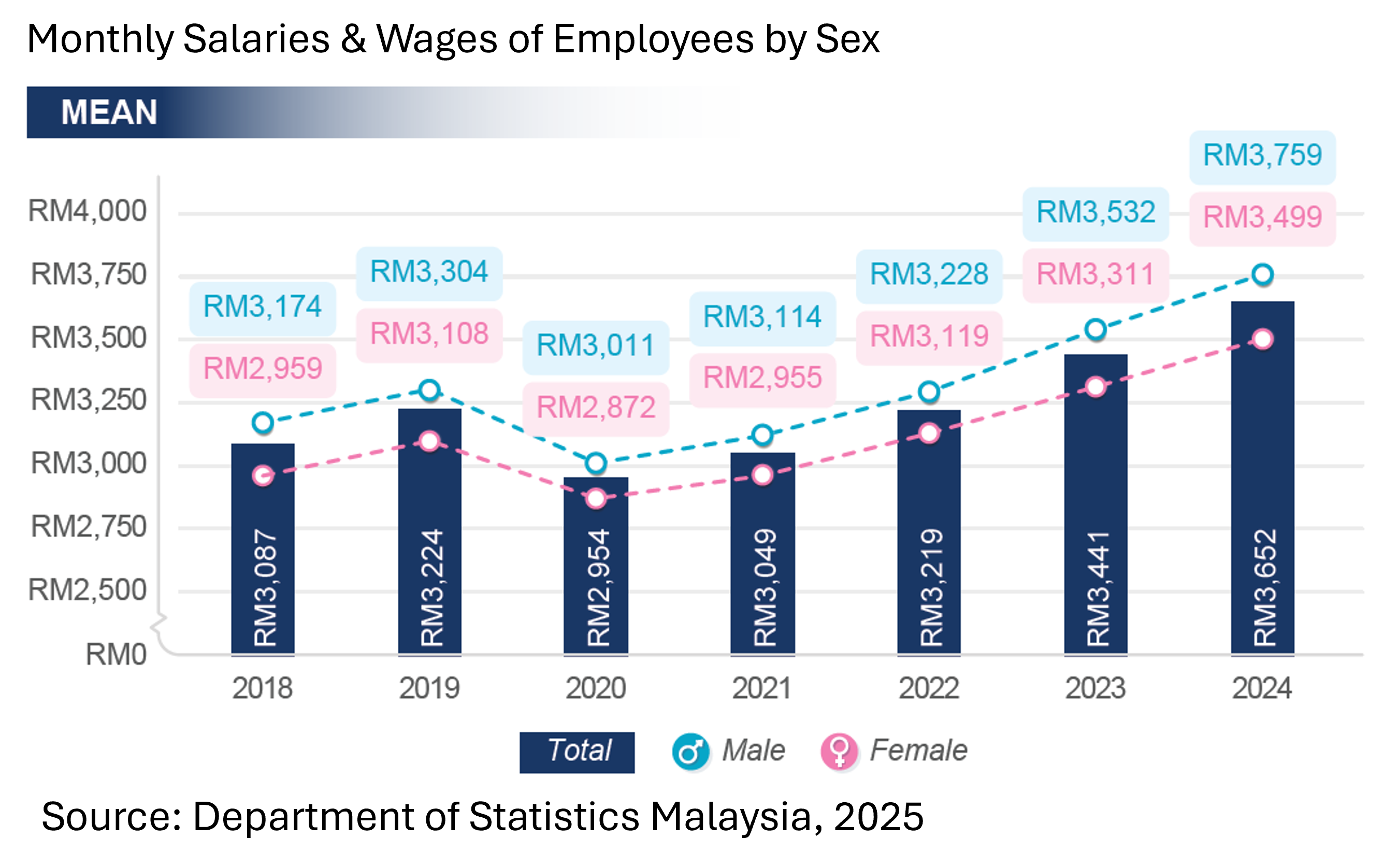
By referencing official DOSM statistics, USM demonstrates transparency and accountability in aligning its remuneration structure with national equity standards. This approach reflects the University’s commitment to equitable employment practices and supports Malaysia’s ongoing progress in eliminating gender-based pay disparities.
Recognition of Labour Rights
Universiti Sains Malaysia recognises and protects labour rights (freedom of association and collective bargaining) for all, including women and international staff. These rights are upheld through institutional representation and national participation in the Malaysian public-sector union system.
The Kesatuan Kakitangan Am Universiti Sains Malaysia (KKAUSM) serves as USM’s officially registered labour union under the Congress of Unions of Employees in the Public and Civil Services (CUEPACS). Through its affiliation with CUEPACS, KKAUSM takes part in national consultations and discussions on employee welfare, salary structures, and working conditions within the public service. This affiliation ensures that USM staff benefit from formal representation at both institutional and national levels.
At the university level, the Standard Operating Procedure of KKAUSM (2025, p. 14) outlines the process for submitting complaints, appeals, and feedback concerning workplace welfare and discipline. Each case is reviewed by the Jawatankuasa Tatatertib, Disiplin dan Perundangan and subsequently presented to the Mesyuarat Ahli Jawatankuasa Kerja for resolution in consultation with USM management.
Through these frameworks, USM demonstrates its commitment to fair representation, constructive dialogue, and equitable working conditions for all employees, in alignment with Malaysia’s national standards for labour rights and social justice.
Maternity and Paternity Leave Policy
Universiti Sains Malaysia (USM) upholds a family-oriented and inclusive employment culture that ensures the well-being and equality of all staff. The University adopts maternity and paternity leave entitlements consistent with the Human Resource Services Circular – Leave Benefits, Version 1.0 (2024) and the national framework under the Employment Act 1955 (Act 265).
According to the Public Service Department (JPA) Circular SR.5.4.1: Kemudahan Cuti Bersalin Pegawai Perkhidmatan Awam (p. 81), USM provides 90 days of fully paid maternity leave for all eligible female employees, including academic, non-academic, and contract staff. This entitlement, which also applies to adoptive mothers, ensures sufficient recovery and bonding time after childbirth while maintaining job security and full remuneration.
In support of shared family responsibilities, USM also provides seven (7) consecutive days of fully paid paternity leave to male employees, as stated under Section 60FA of the Employment Act 1955 (pp. 67). This provision allows fathers to take leave within sixty days of their child’s birth, encouraging active participation in early childcare and supporting maternal health and family stability.
Together, these entitlements reflect USM’s strong commitment to maternity and paternity policies that support all genders equally, promoting gender equality, work–life balance, and family welfare in alignment with SDG 5: Gender Equality.
-
Equity & Inclusion
Non-Discriminatory Admissions Policy
Universiti Sains Malaysia ensures that its admissions process is transparent, equitable, and guided by the principle of non-discriminatory access to higher education. This commitment is articulated in the USM Inclusive Education Policy for Marginalized Students 2025 (pp. 2), which establishes a targeted admission strategy designed to promote inclusion while addressing structural barriers faced by underrepresented and disadvantaged groups.
The policy explicitly states that USM shall implement a targeted admission strategy to ensure equal opportunity and access to higher education for marginalized, underrepresented, and disadvantaged groups. This approach reflects the University’s recognition that positive discrimination, when based on social or economic disadvantage, strengthens equity and aligns with Malaysia’s broader goals of inclusive and sustainable development.
Through this policy, USM guarantees that applicants are evaluated based on merit and potential, while ensuring that individuals from groups such as Indigenous communities, persons with disabilities, and low-income households are given fair consideration and appropriate support to access and succeed in tertiary education.
Tracking Applications of Underrepresented Groups
Universiti Sains Malaysia actively measures and monitors the participation of underrepresented groups in its admissions process to ensure fair access to higher education for all. As outlined in the USM Inclusive Education Policy for Marginalized Students 2025(pp. 1-2), the University commits to tracking applications and admissions of underrepresented and potentially underrepresented groups, including ethnic minorities, students from low-income households (B40), persons with disabilities (OKU), and other disadvantaged communities.
The 2024 student composition data illustrates this commitment to inclusivity:
Student Group Percentage of Total Enrolment Low-income (B40) 75.2% Female 60.9% From developing countries 5.6% Students with disabilities (OKU) 0.5% These figures demonstrate USM’s success in creating pathways for participation among groups traditionally underrepresented in higher education. By collecting and analysing such disaggregated data annually, USM ensures that its admission policies remain inclusive, evidence-driven, and aligned with national and institutional goals for equity in education.
Recruitment of Underrepresented Groups
Universiti Sains Malaysia takes planned and sustained actions to recruit and support students, staff, and faculty from underrepresented groups in line with its inclusive education commitment. The USM Inclusive Education Policy for Marginalized Students 2025 (pp. 1-2) outlines targeted outreach and access programmes to expand participation among marginalized and disadvantaged communities.
In 2024, USM strengthened these efforts through its annual student intake and outreach programmes. During the 2024/2025 academic intake, 31.2 percent of new students were from the B40 income group, together with 20 students with disabilities (OKU) and four Orang Asli students. The University also implemented the Program Siswa SULUNG Malaysia, designed for first-generation students from low-income families.
For staff and broader community engagement, USM collaborated with the Ministry of Human Resources and PERKESO to host the Program Outreach OKU (25 October 2024). The programme focused on employment access, workplace inclusion, and awareness of national services such as MyFutureJobs, while reaffirming USM’s long-term commitment to accessible education and employment for persons with disabilities.
These actions collectively demonstrate USM’s institutional planning and implementation framework to recruit and empower members of underrepresented groups in its academic community.
Anti-Discrimination Policy
Universiti Sains Malaysia upholds a firm institutional policy against all forms of discrimination in its operations, employment, and educational activities. The principle of equality and inclusion is enshrined in the Constitution of Universiti Sains Malaysia under Article 8: Distinction of Race and Creed Prohibited (pp.103), which guarantees that membership in the University, whether as an employee, officer, or student, shall be open to all persons regardless of gender, race, religion, nationality, or class. The article further ensures that no test of religious belief or profession shall be imposed, and that scholarships, awards, or distinctions funded by the University shall not be restricted to any particular group.
To reinforce this constitutional guarantee, USM formalized additional equality and inclusion measures through the USM Sustainability Policy (Revised 2025) (pp. 6–7) and the USM Inclusive Education Policy for Marginalized Students 2025 (pp. 1–2). These policies collectively articulate USM’s zero-tolerance approach toward discrimination, covering employment practices, admissions, student welfare, and accessibility.
Together, these documents establish a comprehensive and publicly accessible policy framework that ensures non-discrimination across all university operations and demonstrates USM’s continuous commitment to social justice, equality, and human rights.
Non-Discrimination Policy for Gender-Inclusive Communities
Universiti Sains Malaysia Inclusive Education Policy for Marginalized Students 2025 reaffirms the university’s strong commitment to providing equitable and inclusive access to education for all, particularly those from marginalized and underrepresented groups such as individuals affected by socio-economic status, disability, gender, displacement, and indigenous background. Guided by Section 6.0 (pp. 2) of the policy, USM upholds the principle of equal opportunity, ensuring that no student is denied access to education based on disability, socio-economic background, ethnicity, gender, displacement, indigenous status, or geographic location. The policy fosters an inclusive learning environment that is safe, respectful, and welcoming to all members of the university community, with a zero-tolerance policy for discrimination, harassment, or exclusion. It provides academic support and inclusive teaching practices, including flexible learning arrangements, assistive technologies, and culturally responsive pedagogy to accommodate diverse learning needs.
In addition, appropriate facilities and accommodations are made available based on specific student requirements, while staff development and training programmes are implemented to enhance awareness and competencies in inclusive practices. Continuous monitoring, evaluation, and accountability mechanisms ensure the effective implementation and improvement of programs, while student voices and representation are actively incorporated into decision-making processes through established university channels. USM is non-discriminatory against women and transgender. Overall, this policy aligns with national and international principles of human rights, sustainability, and social responsibility, fostering a campus culture built on belonging, equity, and inclusivity.
Anti-Harassment Policy
Universiti Sains Malaysia is committed to fostering a safe, respectful, and inclusive campus environment through its Anti-Harassment Policy (Revised 2025) (pp. 1–8), which prohibits all forms of sexual harassment, intimidation, and gender-based violence. The policy applies to all members of the university community including students, staff, and visitors across all teaching, research, residential, and administrative settings.
First approved on 1 July 2009 and reviewed on 1 February 2025, the policy reinforces USM’s zero-tolerance approach toward misconduct that compromises personal dignity, equality, and safety. It is implemented under the supervision of the Jawatankuasa Teras Gangguan Seksual (JTGS), supported by the Legal Office and Ombudsman. The committee handles complaint intake, investigation, and disciplinary processes through the Panel Siasatan Gangguan Seksual.
This policy aligns with the Public Service Circular No. 5 of 2018 and the Sexual Harassment Act 2022 (Act 840), ensuring that USM’s framework meets national and institutional standards for protecting the rights and welfare of its community members.
Protection Policy for Individuals Reporting Discrimination or Misconduct
Universiti Sains Malaysia has established a strong institutional framework to have a policy that protects those reporting discrimination from educational or employment disadvantage, ensuring integrity, transparency, and fairness in all university affairs. This framework is embodied in the Polisi Perlindungan Pemberi Maklumat Universiti (Whistleblower Policy), which safeguards any individual who reports discrimination, harassment, or misconduct within the institution. The policy reinforces USM’s commitment to accountability and ethical conduct across all levels of the university community.
In 2024, the policy continued to serve as a key mechanism protecting staff and students who make disclosures in good faith. It provides confidential reporting channels through the University Ombudsman or Legal Advisor and guarantees that individuals are shielded from retaliation, intimidation, or disciplinary action. These protections apply to employees, students, contractors, and academic partners, as detailed in Whistle Blower Policy (Revised 2025) of Universiti Sains Malaysia (pp. 3-7, Sections 1.1–1.4, 3.3, 8.1, and 9.1–9.2).
The policy explicitly prohibits adverse actions such as dismissal, denial of promotion, exclusion from academic activities, or negative performance evaluation as a consequence of reporting misconduct. It also mandates that the identity of the whistleblower remains confidential except where disclosure is required by law.
Through this proactive policy and its consistent enforcement, USM ensures that all members of its community can report unethical behaviour or discriminatory practices without fear of reprisal, upholding a safe, equitable, and inclusive learning and working environment.
Diversity and Equality Office
The function of a Diversity and Equality Office at Universiti Sains Malaysia is carried out through the Centre for Research on Women and Gender (KANITA), which serves as the institutional focal point for diversity, equity, and inclusion. Established in 1978 as a UNICEF-funded research initiative on women, children, and poverty, KANITA evolved into an autonomous research centre within the University in 2001 following formal endorsement by the University Senate. This reflects USM’s long-standing commitment to integrating gender perspectives and equality principles into higher education, policy, and research.
KANITA operates under the Office of the Deputy Vice-Chancellor (Research and Innovation) and advises the administration on gender and diversity policies, implements equality-focused programmes, and conducts capacity-building training related to human rights, gender sensitivity, and inclusive practices. In 2024, KANITA began coordinating the development of the forthcoming USM Gender Equality Policy, which is under institutional review and expected to be finalised in 2025.
Through research, outreach, and training, this office continues to advance the values of diversity, equity, inclusion, and social justice that are embedded in the USM Sustainability Policy 2024 (pp. 6–7) and reflected in the University’s strategic direction towards inclusive governance and community empowerment.
Support for Underrepresented Groups
Universiti Sains Malaysia provides structured mentoring, counselling, and peer support programmes designed to assist students, staff, and faculty from underrepresented and diverse backgrounds. These initiatives reflect the University’s commitment to building an inclusive learning and working environment that promotes equity and well-being for all members of its community.
Through the Pusat Transformasi Insan (Human Transformation Centre), USM offers psychological counselling, mentoring, and training focused on mental health, resilience, and life skills. The Unit Kebajikan dan OKU under the Student Affairs Division (BHEPA) provides individualized support and peer mentoring for students with disabilities and those from low-income households. The KAWAN Programme, managed by the International Mobility and Collaboration Centre (IMCC), assists international students in adapting to campus life through peer-led guidance and cultural exchange activities.
The Centre for Research on Women and Gender (KANITA) complements these initiatives through mentorship and awareness programmes that advance gender equity and social inclusion. Collectively, these efforts ensure that underrepresented students, staff, and faculty have access to comprehensive emotional, academic, and professional support, reinforcing USM’s culture of diversity and belonging.
Disability Support Services
Universiti Sains Malaysia is committed to promoting equitable access and full participation for persons with disabilities (OKU) across its campuses. Through its Pusat Transformasi OKU USM, the University provides integrated support services that combine rehabilitation, empowerment, accessibility, and vocational development to foster inclusion and independence.
The centre adopts a holistic and community-based approach, offering counselling, assistive mobility services, and customized rehabilitation programmes. Key initiatives include:
- Transportation assistance and accessible accommodation (93 units) to enhance campus mobility and comfort.
- Peer mentoring and advocacy via Sekretariat Insan Istimewa USM, promoting social inclusion and leadership among OKU students.
- Vocational and empowerment training through specialized programmes:
- VT@USM: Job-readiness and vocational training for persons with intellectual disabilities.
- WC@USM: Customized wheelchair modification to improve mobility and independence.
- Community-Based Rehabilitation Centre: Therapy, skill-building, and family counselling using an occupational therapy model.
- USM–JKM Agricultural Training Centre: Hands-on agricultural and entrepreneurship training for OKU trainees.
These initiatives reflect USM’s systematic application of inclusive education principles, emphasizing capacity building, equal opportunity, and social participation. By integrating rehabilitation, vocational training, and accessibility measures, USM strengthens its commitment to a learning environment where all individuals can thrive.
Disability Access Schemes
Universiti Sains Malaysia provides access schemes for people with disabilities such as mentoring and other targeted support through the Pusat Transformasi OKU USM, a dedicated one-stop centre that delivers personalised and group-based assistance. The centre uses a case management and empowerment model to ensure that students and staff with disabilities receive the specific guidance and resources they need to achieve full participation in university life.
Under the One-Stop Centre, the following support services are provided:
- Individual mentoring and counselling for students and staff with disabilities, addressing adjustment, emotional well-being, and academic performance.
- Targeted support programmes focused on accessibility, employability, and personal development, coordinated with university departments and community partners.
- Peer mentorship and advocacy through Sekretariat Insan Istimewa USM, which connects OKU students with peer mentors to build confidence, social inclusion, and leadership.
- Referral services linking students to relevant facilities, rehabilitation programmes, and financial aid.
The One-Stop Centre functions as an integrated access hub for all OKU-related services at USM, ensuring that every member of the community with a disability receives appropriate mentoring and targeted support within an inclusive academic environment.
Disability Accommodation Policy
Universiti Sains Malaysia ensures equitable access and inclusion for persons with disabilities (OKU) through its Dasar Orang Kurang Upaya (OKU) Universiti Sains Malaysia 2020 (Revised 2025) (pp. 10–13), which establishes a formal framework for reasonable accommodation and support across academic and living environments. The policy mandates the provision of assistive devices, accessible campus infrastructure, and housing adjustments according to available institutional resources (Sections 3.7 and 3.9).
As part of this framework, students with disabilities are offered on-campus accommodation options that include single or twin-sharing rooms equipped with accessible facilities such as shared bathrooms, laundry rooms, study areas, and cafeterias. Monthly rental rates range from RM 150 to RM 330, significantly below market price, ensuring that accommodation remains financially accessible to all disabilities students.
The implementation of these accommodation provisions is coordinated by the Bahagian Hal Ehwal Pembangunan Pelajar & Alumni (BHEPA) and the Pusat Transformasi OKU USM, both of which ensure that reasonable accommodation and adequate funding are embedded within USM’s inclusive campus strategy.
-
Policies
-
Partnership
-
发布报告
理大承诺每年发布一份全面报告,详细阐述与可持续发展目标(SDG)1-17相关的活动和项目。通过各项举措,理大展现其对可持续发展的坚定承诺,并积极推动SDG议程的落实。
- 2018 年理大可持续发展目标报告
- 2019 年理大可持续发展目标报告
- 2020 年理大可持续发展目标报告
- 2021 年理大可持续发展目标报告
- 2022 年理大可持续发展目标报告
- 2023 年理大可持续发展目标报告
理大的财务数据包含在马来西亚审计总署报告的理大财务报表中。
USM committed to publishing a comprehensive report specifically addressing activities and programs related to SDG 1-17 annually. USM's commitment to sustainability and its various initiatives demonstrate its efforts in contributing to the overall SDG agenda.Financial data highlights for USM are shown in the Document Reported by Auditor General of Malaysia in USM Financial Statement


