


-
Low-Carbon Energy
Measuring and Tracking Low-Carbon Energy Use Across Universiti Sains Malaysia
Universiti Sains Malaysia systematically measures and monitors low-carbon energy consumption across the whole university in alignment with the USM Energy Policy (Revised 2025) and the USM Sustainability Policy (Revised 2025). Both policies emphasize the transition toward renewable energy, the reduction of greenhouse gas (GHG) emissions, and the efficient management of electricity in support of SDG 7 (Affordable and Clean Energy) and SDG 13 (Climate Action).
In 2024, the university tracked its total energy consumption and renewable energy generation through official utility records covering the whole institution. The data show that USM consumed a total of 63,995,989 kWh (equivalent to 230,386 GJ) of electricity across its three campuses, namely the Main Campus, Engineering Campus, and Health Campus. Of this total, 18,259,661 kWh (equivalent to 65,735 GJ) was generated from low-carbon sources, primarily through the Solar Photovoltaic (PV) System under the Net Energy Metering (NEM) scheme. Please refer graph below:
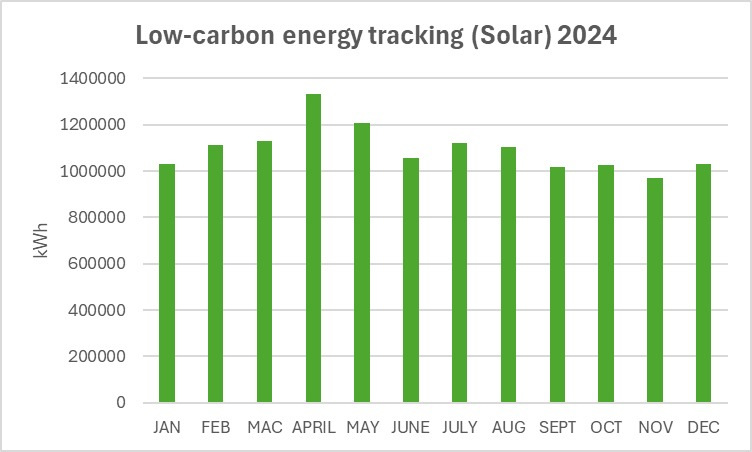
This represents approximately 28.5 percent of total energy use derived from renewable, low-carbon energy across the whole university. The solar PV systems installed at the Main and Engineering Campuses operate under a continuous energy monitoring process that tracks monthly generation and grid imports. The data collection is part of the Energy Saving Measures (ESM) initiative, which ensures compliance with the national energy-efficiency standard MS 1525:2007.
The Development and Facilities Management Department compiles and reports these figures through monthly performance tracking, verifying solar output against total electricity demand. This transparent monitoring mechanism ensures that renewable energy use is accurately accounted for and reported in Gigajoules (GJ).
USM’s ongoing low-carbon energy tracking serves as a foundation for its long-term target to achieve 50 percent renewable energy share by 2050 and move progressively toward carbon neutrality. Through systematic energy measurement, transparent reporting, and strong policy enforcement across the whole university, USM continues to demonstrate institutional leadership in advancing sustainable energy management within higher education.
-
碳中和大学
在理大,我们坚定致力于打造碳中和大学。我们的可持续发展承诺涵盖碳排放的三个关键领域——范围1、范围2和范围3,并通过持续努力最大限度地减少对环境的影响。
范围1: 碳排放主要源自大学拥有或控制的设施和设备,包括校园车辆等。理大积极采取措施减少此类排放,例如定期评估并升级校园交通工具,以降低直接碳排放,从而减少校园整体碳排放量。
范围2:碳排放源自理大从外部供应商购买的电力生产。因此,理大正积极投资可再生能源和高效节能技术,以降低对传统能源的依赖。通过转向更清洁的能源来源,我们正在减少间接排放,稳步迈向碳中和目标。
范围3:属于间接碳排放,虽源自大学活动,但排放源并非理大直接拥有或控制,包括废物处理及其他运营环节的排放。理大积极与社区和供应商合作,降低这些活动产生的碳排放,并致力于实施可持续采购,鼓励使用公共交通和拼车,同时减少废物产生。
我们对碳中和的承诺不仅限于校园范围,而是扩展至更广泛的环境影响。鉴于我们的行动对整体生态系统的深远影响,理大积极采取全面措施,涵盖所有类别的碳排放。通过系统性地减少范围1、范围2和范围3的碳排放,我们正推动可持续发展,为大学及其服务的社区创造更加绿色、低碳的未来。
理大每年开展全校范围的低碳能源追踪,监测各部门的低碳能源使用量,以评估和优化整体能源消耗。
让我们共同迈向碳中和大学的目标,将可持续性与环境责任融入我们的核心使命。点击这里,了解我们的低碳校园实施计划。
-
Climate Resilience and Partnership

建成环境
我们的使命是通过创新实践和解决方案推动建成环境的可持续发展,应对关键挑战,并以可持续发展目标作为指导原则.

水资源
在校园内培育负责任的水资源使用和节水实践是我们实现 2030 年可持续发展目标的承诺。

废弃物
通过集体努力和持续改进,我们的使命是减少废弃物、推动回收利用,并打造一个践行可持续发展理念的校园。

能源
通过这些举措,理大确立了自己作为可持续发展领导者的地位,提供可行的模型来指导政策和决策。通过整合研究、教育和倡导,理大支持推动全球范围内可持续解决方案的清洁能源政策。

气候变化
在理大,我们坚定致力于打造碳中和大学。我们的可持续发展承诺涵盖碳排放的三个关键领域——范围1、范围2和范围3,并通过持续努力最大限度地减少对环境的影响。

健康与身心平和
我们尽力通过提供卓越的教育、促进前沿研究以及促进社区参与健康与身心平和,帮助个人过上更健康的生活。

生物多样性与生态系统
我们的使命是成为地球的守护者,致力于通过研究、教育、社区参与和可持续实践来保护生物多样性和生态系统。